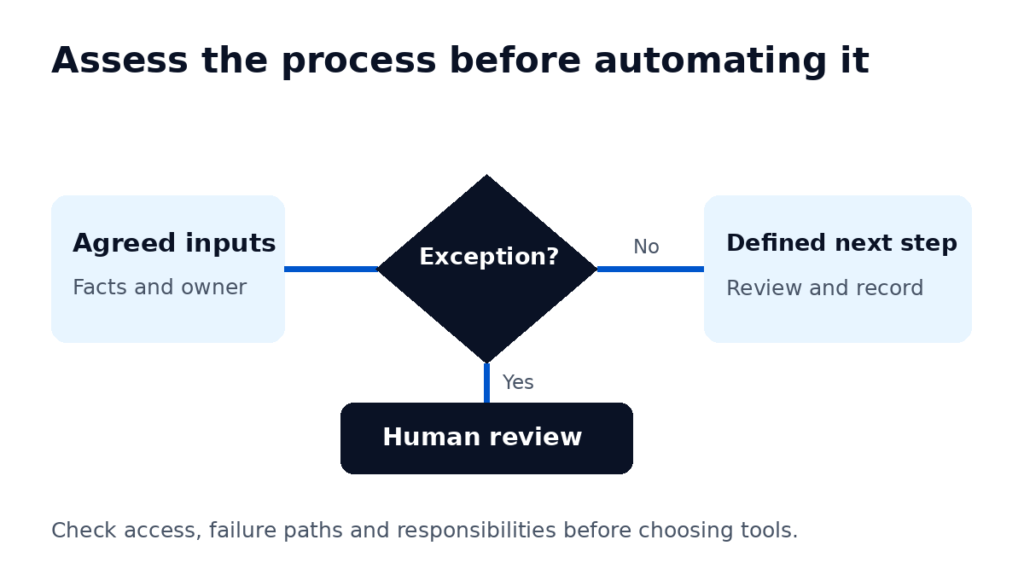
Automation is worth considering when a repeatable task has a clear trigger, owner and completion condition. Begin by understanding your onboarding process. A tool cannot resolve an unclear handoff simply by moving it faster.
Map the current handoff
Follow one recent onboarding journey using records you are authorized to review. Note what starts the process, which information is requested, who checks it and how the next person knows it is ready. Separate a required business step from a habit that no longer serves a purpose.
Use this readiness checklist
- Trigger: what specific event should start the step?
- Input: what information is essential, and who provides it?
- Owner: who is responsible when the information is incomplete?
- Completion: how is success recorded and communicated?
- Exception: what happens if the step fails, duplicates or needs a human decision?
Keep sensitive decisions deliberate
Review access, consent, retention and the sensitivity of the information involved with the appropriate owner. Do not copy personal information between systems just because a connector makes it possible. Legal and privacy requirements need verified inputs for the actual business and jurisdiction.
Some tasks may suit a reminder or status update; others need judgment or a direct conversation. Treat any proposed workflow as a design to test, not evidence that the business already has an installed capability.
Pilot one bounded step
Choose a low-risk, reversible task. Define test inputs, expected behavior and a manual fallback. Check duplicate events, missing information and failures as well as the happy path. Confirm who monitors the process after handover.
How do we know whether it helped?
Record a baseline for the same task before the change, then compare actual time, corrections and exceptions over a stated period. Keep tool fees and maintenance effort visible. Do not claim a percentage saving without measured records or generalize one result to every business.
Do we need a new tool first?
Not necessarily. A clearer checklist, ownership rule or message may address the immediate issue. Review existing tools and their limits before adding a subscription.
We’ll assess the current workflow and recommend a practical direction, including where a human handoff should remain. The right scope depends on your process, constraints and evidence. Discuss your requirements.