If you are comparing WordPress website proposals, a brief gives every supplier the same problem to solve. Without one, a five page brochure, a bespoke booking system and a website with inquiry tracking can all arrive under the same label: “website development”. Their prices may look comparable while their scope is completely different.
This guide is for service business owners buying a first website or replacing one that no longer supports the business. It includes a practical briefing worksheet and acceptance checks you can use before launch.
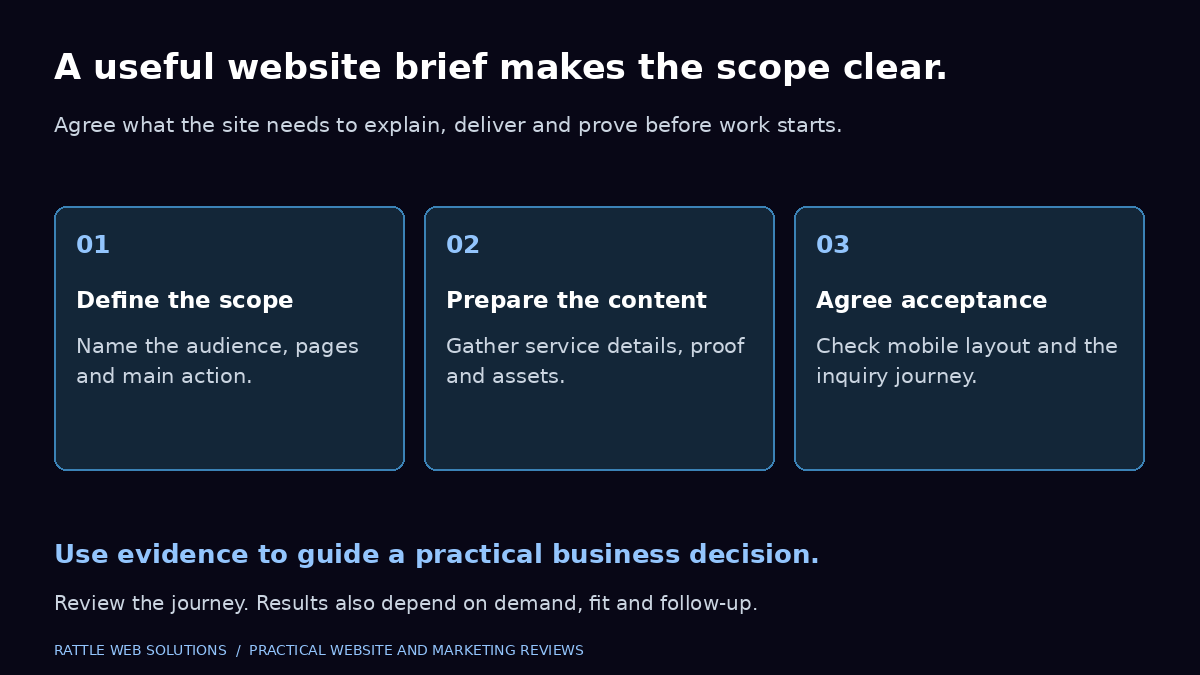
- Buyer and purposeDefine who the website helps and what they need.
- Scope and ownershipAgree pages, content, access and costs.
- Test and hand overVerify the inquiry route and ongoing responsibility.
Start with the decision your buyer needs to make
“We need a modern website” describes an appearance. It does not explain the work the website must do.
Try a more useful sentence: “We need local commercial property managers to understand our maintenance service, see whether we cover their locations, and request a conversation about their portfolio.” Now a designer can identify the audience, scope, buying questions and conversion route.
A website serving homeowners will need different information from one serving procurement teams. A buyer booking a venue may need capacity, location and availability. A buyer commissioning a professional service may need specialisms, evidence, process and commercial fit. Both need clarity. The information that creates clarity is different.
Write your brief around one primary buyer group first. Record secondary groups separately. If everyone is equally important, the homepage often ends up speaking clearly to nobody.
The first paragraph of your brief
Complete these four sentences in plain language:
- Our business provides this service: …
- Our most important buyer is: …
- They usually need help when: …
- After visiting the website, a suitable buyer should: …
Include the real delivery geography. If you serve clients remotely from India, explain that arrangement accurately. Do not ask a website supplier to create the impression of a US office you do not have. Buyers can work with international providers when communication, scope and accountability are clear.
Separate the website problem from the marketing problem
A website cannot solve every acquisition problem on its own. An excellent inquiry page does little if nobody relevant reaches it. More traffic does little if the service, evidence or next step is unclear.
Describe the current problem using evidence where possible. That might mean buyers asking questions already answered on the site, mobile visitors struggling with a form, or the sales team receiving requests for services you do not offer. Avoid presenting guesses as facts.
If you have analytics, record the reporting period and the limits of the data. A high exit rate is not proof that a page is poor. A phone button click is not proof of a connected conversation. If you have no reliable measurements, state that openly and include measurement planning in the brief.
The Build Online Presence solution is relevant when discoverability and credibility are the immediate gaps. If suitable visitors are already arriving but not inquiring, review the buying journey before commissioning an entirely new website.
Define the pages by their job, not just their names
A page list is useful. A page list with a purpose is better.
| Page | Buyer question it answers | Desired next step |
|---|---|---|
| Home | Is this business relevant to my situation? | Explore the right service or solution |
| Service page | Does this service solve my specific problem? | Review scope and inquire |
| About | Who will I be trusting with the work? | Build confidence and continue |
| Case study | What did this business actually do? | Understand evidence and suitability |
| Pricing | Is the commercial model appropriate for me? | Discuss a defined scope |
| Contact | How do I start, and what should I share? | Submit a usable inquiry |
Some businesses need additional pages. Multiple genuinely different services may need separate explanations. A resource library needs a listing page. A booking flow needs availability, confirmation and operational ownership. None of those should be added merely to reach a page count.
For a rebuild, include the existing URL beside every proposed page. Decide which content stays, changes or retires. Ask who will manage any necessary redirects. Deleting an old page without reviewing its links and search visibility creates avoidable risk.
Make content responsibility explicit
“Content included” can mean several things. It may cover transferring existing text, lightly editing it, interviewing your team, writing from a brief, or producing a complete evidence led content plan. These are different amounts of work.
Your brief should identify the owner of each content type:
- Service descriptions and exclusions.
- Prices, payment terms and commercial approval.
- Team biographies and business details.
- Client permissions, testimonials and case study evidence.
- Photography, illustrations and diagrams.
- Privacy notices and other necessary legal wording.
- Blog content and future updates.
Ask whether the supplier is writing, editing or simply uploading each item. Ask how many review rounds are included and who gives final approval. One named approver usually produces clearer decisions than a stream of contradictory comments.
Do not fill evidence gaps with invented testimonials, stock project names or impressive percentages. If you have no approved case study yet, explain your process and the work a client receives. Honest detail is more useful than borrowed credibility.
Describe the inquiry journey before choosing a form
Think beyond the submit button. A form is useful only if a suitable person can complete it and the business receives and acts on the inquiry.
Specify the primary contact route, the information needed for a useful response, the destination of the inquiry and the person responsible for follow up. Record any realistic expectations about what happens next. Do not publish a promised response time unless the team can meet it.
A simple professional service form might ask for a name, business email, website, service of interest and a short description of the problem. A local venue may need an event date and approximate group size. A long qualification form can be justified when those answers materially change eligibility, but every field should have a reason.
Agree the treatment of failures too. What happens if an email notification fails? Is the inquiry saved in a supported system? Can the team identify duplicate submissions? Can buyers use an alternative contact route? These questions belong in the brief, not just in a launch day checklist.
For measurement, distinguish a form start from an accepted submission and an accepted submission from a qualified lead. Your supplier should not label every contact click as a customer opportunity.
State your design boundaries
Reference websites can help explain taste, but “make it like this” is not a complete design brief. Identify what you like: the section spacing, readable type, restrained colors, clear comparison tables or way a case study is presented.
List your existing brand colors, logo assets and any usable photography. Explain whether the supplier should preserve your identity or propose a change. If visual content needs to be created, define its purpose. A diagram explaining a buying process should communicate accurately; it should not resemble a dashboard full of invented results.
Ask for a design that works with real content. Long service names, genuine FAQs and variable article titles should not break the layout. Request a mobile review of the actual contact route, not only a screenshot of the desktop hero.
Accessibility also belongs here. Buyers need readable contrast, visible keyboard focus, clear labels and controls they can operate. Animation should support orientation and respect reduced motion preferences. A premium design should be easier to use, not harder to interpret.
Clarify ownership, accounts and recurring costs
You should know which accounts your business owns and which services depend on the supplier. Record the domain registrar, hosting, WordPress administrator access, analytics property, advertising accounts and any paid theme or plugin licences.
For each recurring service, ask:
- Who pays for it?
- What is included in the quoted price?
- When does it renew?
- What happens if the agency relationship ends?
- Can another provider maintain the site without rebuilding it?
Do not send passwords in a general project brief. Access can be arranged later through the platform’s supported invitation or secure handover process. A plan to give access is not a reason to share credentials by email.
The WordPress website service and pricing page explain Rattle’s current starting scope. A proposal should still state the exact total, inclusions and any optional external costs before work begins.
Include maintenance and handover
A launch is a change of responsibility, not the end of the website’s life. Decide who handles updates, backups, uptime concerns, content changes and security maintenance after launch. Ask what is included initially and what becomes a separate service.
For a rebuild, ask for a migration and rollback plan. WordPress’s migration tutorial covers backup and migration considerations. Your project still needs an approach suited to its actual hosting, content and integrations.
Handover should include the agreed access, a short explanation of routine edits, a list of integrations, licence responsibilities and a record of acceptance checks. If your team will publish articles, test that task during handover. If only the supplier can edit a basic paragraph, clarify the dependency before signing off.
A copyable website brief
Use this worksheet as a starting point. Unknown answers can be marked “to be agreed”; do not guess to make the document look complete.
| Brief field | What to record |
|---|---|
| Business and audience | Offered services, primary buyer, location and delivery model |
| Current problem | Observations, relevant reporting period and uncertainty |
| Primary action | Inquiry, booking or another specific buyer action |
| Page scope | Page name, purpose, existing URL and proposed owner |
| Content | Supplied materials, writing responsibilities and approval owner |
| Evidence | Approved client stories, permissions and source records |
| Design | Brand assets, references and accessibility expectations |
| Integrations | Forms, CRM, booking, payments and responsible accounts |
| Measurement | Events, success conditions and validation owner |
| Commercial scope | Budget range, inclusions, exclusions and recurring costs |
| Launch | Migration, redirects, testing, backup and rollback |
| Handover | Access, documentation, training and maintenance |
How to compare proposals against the brief
Do not compare only the headline amount. Ask each supplier to mark every requirement as included, optional, excluded or awaiting clarification. This turns a vague sales conversation into a scope comparison.
Pay particular attention to content, inquiry delivery, mobile testing, migration, recurring licences and handover. Those are common places where two apparently similar proposals differ. Also check how additional pages or revisions are priced if your scope changes.
An inexpensive proposal may be appropriate for a simple, tightly defined website. A larger proposal may be appropriate when content, integrations and migration genuinely require more work. Neither is automatically better. The useful question is whether the promised work addresses your actual buyer journey and can be verified.
Acceptance checks before you approve launch
Review the website as a prospective customer, then as the person responsible for the business.
Confirm that the main service and geography are clear, the evidence is approved, commercial information matches the agreed offer, and all important links lead to the right destinations. Test navigation and forms on a phone. Check keyboard use and visible error messages.
With permission, carry out a controlled inquiry test and verify that the correct destination receives it. Confirm that measurement records the agreed success condition once, rather than counting a button click or a direct thank you page visit as a lead. Review redirects and metadata for pages changed during the rebuild.
Keep an unresolved issue list. A visual polish item is different from an inquiry route that does not work. Agree which issues block launch and who owns the rest.
The next useful step
You do not need to know which WordPress blocks or plugins to use before discussing a project. Bring the buyer, the problem, the current website and the outcome you need. Those inputs make the technical choices more useful.
If you want help turning that information into a practical website scope, share your business and website with Rattle. The aim is to identify what your next stage requires before committing to pages, features or a larger marketing spend.
Questions business owners often ask
How detailed should a website brief be?
Detailed enough that two suppliers understand the same audience, page scope, content responsibility and inquiry journey. A short brief with those decisions is more useful than a long document of visual preferences without a business purpose.
Should SEO be included in a website brief?
Include discoverability requirements such as useful page structure, metadata, crawlable links and preservation of important URLs. Clarify whether research and ongoing content are part of the project or a separate scope. A website launch does not guarantee rankings.
Should I rebuild or improve the existing website?
Base the decision on the existing platform, buyer journey, maintenance constraints and evidence. If the main gaps are content, navigation or one form, targeted improvements may be more proportionate. A rebuild needs a clear reason beyond wanting a new appearance.
Can I use one page for every service?
A single page can work for a narrow offering. Distinct services with different buyer questions often need separate explanations. Choose the structure around useful information, not an arbitrary page count or a promise that more pages automatically create more traffic.