
Turn website visits into useful inquiries
Being found is a starting point. Your ads and website also need to answer the buyer’s questions, explain the offer and make contacting you feel worthwhile.
Discuss your next step- Relevant interest
Start with the service and intent behind the visit.
- A clear decision
Explain the offer, fit and evidence.
- Received inquiry
Make contact usable and confirm what happened.
An approach to the work, not a prediction of results.
YOUR CURRENT PRIORITY
Connect relevant interest with a usable next step
Your website inquiries are inconsistent, even when visits increase. Or you have a credible presence and want to test whether search demand can bring useful conversations.
First, separate the audience problem from the page problem. Relevant buyers need a clear offer, useful answers and an easy next step. A better button cannot fix the wrong traffic.
THE USEFUL WORK
Make the contact step easier to understand
Choose the work that addresses the gap. Each task should have a purpose, a defined scope and a way to review it.
Match the search to the offer
Review the service, location and intent behind the traffic. Connect relevant Google Ads themes with pages that address that specific need.
Answer the questions that delay contact
Make scope, suitability, proof, pricing guidance and the process easier to find. Use genuine examples instead of unsupported result claims.
Remove friction from the inquiry path
Review mobile readability, calls to action, form questions and contact routes. Keep useful qualification questions without asking for information you do not need yet.
Measure successful inquiries
Separate submit-button clicks from completed submissions, then confirm receipt in the business record. Phone and WhatsApp clicks remain separate signals unless conversations are confirmed.
HOW WE WORK
Connect the offer, landing page and contact route
Find the bottleneck
Review source and landing-page data alongside the actual pages and inquiry handling. Prioritize evidence of friction over personal preferences about design.
Improve one meaningful journey
Agree the campaign and page changes most likely to help the intended buyer. Preserve clear conversion definitions so comparisons remain useful.
Review results in context
Look at relevant visitors, genuine inquiries and lead quality over a suitable period. For low traffic, use practical usability checks before claiming a statistical experiment has a winner.
EVIDENCE BEFORE ASSUMPTIONS
Review received inquiries and buyer fit
Review the rate of received inquiries among relevant visitors, inquiry volume by landing page and the proportion that fits your service. More form submissions are not an improvement if they create more unsuitable conversations.
MATCH THE SERVICE TO THE GAP
Support the journey from search to inquiry
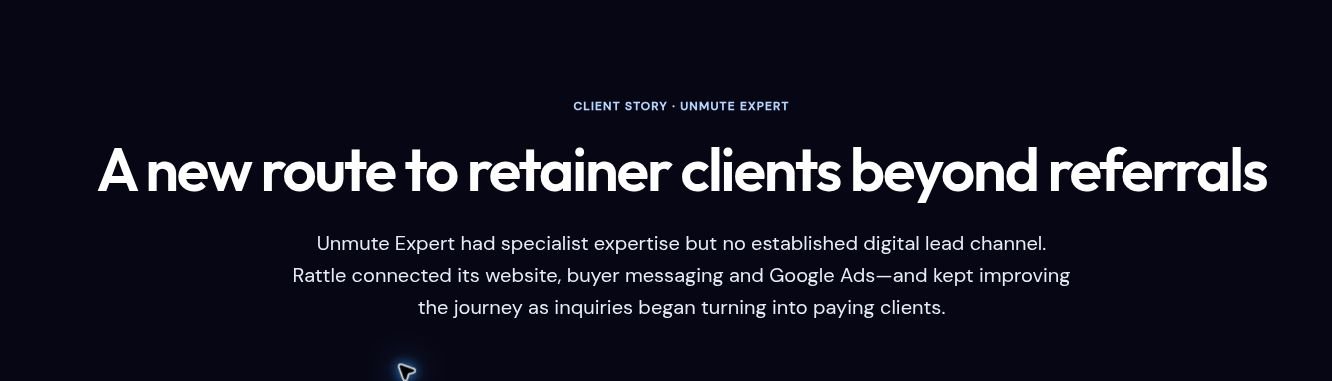
CASE STUDY · UNMUTE EXPERT
Build a new route to retainer clients.
Rattle worked on the website, buyer messaging, Google Ads and inquiry journey for a specialist service business.
6 active retainer clients
Reported by the owner in October 2026. The story also reports approximately 6–10 inquiries per month; the acquisition channel for the retainers is not specified. This is one business’s experience, not a forecast.
Read the Unmute Expert case studyPLANS & PRICING
Compare support for your inquiry journey.
Compare current service scope and pricing. Advertising spend is separate; website work and integrations depend on the agreed scope and capacity.
FREQUENTLY ASKED QUESTIONS
Good questions. Clear answers.
Ad budgets, landing-page improvements and how we review inquiry quality.
Should I increase my advertising budget first?
Review intent, landing-page clarity and measurement before increasing spend. More traffic can amplify an existing gap; it does not automatically solve it.
Can you improve my current landing page?
Yes, subject to its platform and agreed scope. We can assess content, layout, contact routes and campaign alignment before deciding whether a replacement is needed.
How will we know the changes helped?
Use consistent event definitions and compare relevant traffic, successful inquiries and quality. Small samples and changes in demand limit what a short comparison can establish.
What should I share for an inquiry journey review?
Share the service you want to sell, the buyers and locations it serves, the landing-page URL and how people currently find it. Describe where visitors get stuck and who receives and follows up inquiries. If available, include a date range with aggregate visits, received inquiries and qualified leads; no customer names or private records are needed. We can still start with a practical page review when reliable data is unavailable.
Let’s talk about your goals.
Share your service, target buyers and landing-page URL. Tell us what happens between a visit and a received inquiry. Include useful totals if available; unknowns are fine.
Get a Lead Plan