Paying someone to upload a fixed number of posts is not the same as having a useful local customer journey. A business can publish regularly while its opening hours are wrong, its main service is unclear or callers cannot reach the right person.
This guide helps local service businesses compare a monthly management proposal. It explains practical inclusions, sensible boundaries and the questions worth asking before you commit.
- Accurate informationRepresent the real business, services and hours.
- Useful evidenceCoordinate genuine photos, feedback and updates.
- Business reviewSeparate profile actions from actual inquiries.
First decide whether monthly management is necessary
Not every business needs a large ongoing retainer. A stable single location with accurate information, an active owner and a small set of services may need an initial cleanup and a manageable maintenance routine.
A business with changing hours, multiple services, new photos, regular customer questions or several locations may benefit from ongoing coordination. The need becomes stronger when nobody internally owns the profile and important updates are repeatedly missed.
Start with the business problem: are customers seeing incorrect details, struggling to understand the offer, or finding the profile but failing to make contact? A provider should explain which of those gaps the proposed work addresses.
Do not buy a monthly package solely because a competitor appears in Maps. Your category, customer location, evidence, website and real business operations all matter. Google describes local results as depending mainly on relevance, distance and popularity, with prominence explained in its local ranking guidance. A management fee cannot purchase a guaranteed position.
Separate the initial setup from ongoing work
An initial engagement should establish the baseline. This might include checking ownership, profile eligibility, information accuracy, category choices, services, contact routes, website links and available evidence.
Monthly work should then maintain and improve that baseline. A proposal should not charge indefinitely for an initial audit without explaining the recurring work.
| Initial work | Ongoing work |
|---|---|
| Confirm ownership and access | Review access when responsibilities change |
| Check business details and service representation | Keep approved information current |
| Establish a content and photo baseline | Add genuinely useful new information |
| Agree review handling | Coordinate timely, appropriate responses |
| Check contact and website routes | Monitor reported contact friction |
| Define measurement and limitations | Review performance and business feedback |
Ask whether initial cleanup is included in the first month, priced separately or dependent on the profile’s condition. An unresolved verification or ownership problem is different from routine content management.
Accurate business information comes first
A customer should be able to identify what you offer, where and when you operate, and how to contact you. Inaccurate information can waste the customer’s time and your team’s effort.
Agree who supplies changes to opening hours, holiday schedules, contact details, service availability and business operations. The agency cannot reliably infer those facts. The owner or a named staff member needs a simple way to communicate updates.
The provider should also explain how proposed edits are approved and recorded. Business names, categories, address arrangements and service areas should describe the real business rather than become a place to insert attractive search phrases.
A service area should reflect where you actually deliver. It is not a mechanism for making a business appear equally close to every searcher. If a business is opening a new location, confirm its operational and platform eligibility before treating it as another marketing asset.
The profile should help buyers understand your services
Completeness is useful when it adds meaning. A long list of services is less useful if buyers still cannot tell which one fits their need.
Review descriptions for clarity, suitability and alignment with the website. A customer moving from the profile to a service page should see the same business, offer and contact information. If one surface advertises an obsolete package, the handover becomes confusing.
Think about the questions that recur in genuine inquiries. Customers may need to know whether you serve commercial properties, accept a particular type of event, or travel to their area. Where the platform supports that information, represent it accurately. The website can provide fuller explanations.
This is also a reason to coordinate local profile work with website creation or improvement. The profile creates an opportunity to be considered. The destination page helps the buyer decide whether to continue.
Photos should show the real business
Useful photography can help buyers recognize a location, understand a service or judge whether the business is appropriate. A monthly scope should explain what photography is expected, who supplies it and whether editing or original photography is included.
For a venue, genuine room layouts and event spaces may answer practical questions. For a local service provider, real team and service photographs can show what the business actually does. A new generic stock photo every week may add little.
Keep permissions and accuracy clear. Do not use client images without the required approval. Do not present generated scenes as evidence of a real premises, team or completed project. A decorative illustration may be suitable on a website when its role is clear; it should not masquerade as documentary photography.
Create a short photo request list based on buyer questions. “Show the entrance customers will use” is more useful than “send ten photos”. It makes the work easier for the business and more relevant to customers.
Reviews need an honest operational process
A provider can help coordinate review requests and responses, but the reviews must come from real customer experiences and follow the platform’s rules. Buying reviews or inventing testimonials is not a credible growth strategy.
Agree how the business identifies customers who can be invited to share an experience, how requests are sent, and who approves responses to sensitive issues. Do not make a positive review a condition of receiving a benefit, and do not build a process that selectively invites only happy customers while suppressing others.
Responses should sound like the business and protect privacy. A public reply should not disclose details of a customer’s booking, account or dispute. Complaints may need a private operational response before any public wording is finalised.
Monthly reporting should describe the work and genuine patterns in feedback. A target review count is not a licence to create pressure or misrepresent outcomes. The provider should explain what depends on actual customers and the business’s service quality.
Useful updates are better than a content quota
Posts and updates can communicate real changes, relevant services, offers with clear conditions or information customers need. They should have a purpose beyond filling a calendar.
A proposed content routine should answer: who is the update for, what should they learn, and what can they do next? Seasonal opening information, a genuine service clarification or approved new photography can be useful. Repeated generic claims about being “the best” usually are not.
Ask how content is approved and how the agency learns about the business. If every update could belong to any company in the category, the scope is probably not capturing enough useful information.
Do not assume that publishing a certain number of posts guarantees local ranking improvement. Evaluate the work as part of a complete profile and buyer journey, with a clear reporting boundary.
Reporting should distinguish actions from customers
Google’s Business Profile performance documentation explains available metrics and their limitations. For example, the calls metric counts clicks on the call button; directions represent requests, not verified visits. The documentation also says performance can include activity from organic results and Google Ads.
A good report should state the period, relevant metrics and what cannot be inferred. It should not relabel all direction requests as store visits or all phone clicks as booked customers.
Connect the report to the business’s own inquiry records. Ask what callers wanted, whether the requested service and location were suitable, and whether customers progressed. A simple weekly log can be more useful than a complicated dashboard if it is maintained consistently.
The qualified lead guide provides a practical definition. If website events are unclear, conversion tracking setup can help separate contact actions from confirmed receipt. Neither replaces the business’s responsibility to record sales outcomes accurately.
Ownership and access should stay clear
Your business should understand who owns the profile and which people or agencies have access. Use supported invitations and appropriate permissions. Do not send passwords as the default way to start an engagement.
Ask what happens when the contract ends: which access is removed, what documentation is handed over, and how the business continues managing its information. A supplier relationship should not make the business dependent on an account it cannot recover.
The proposal should also identify who communicates with Google about problems and what work is covered if verification, a suspension or an ownership dispute occurs. Those issues can require separate evidence and platform review. A monthly content package should not imply guaranteed resolution.
Compare the scope, not just the monthly fee
Two proposals can use the same service name while including very different work. Compare the number of real locations, initial setup, content responsibilities, review coordination, reporting, website work and support boundaries.
Ask about excluded or optional costs before work begins. Photography, website changes, advertising management and advertising media are not automatically included in a profile management retainer. A useful proposal explains what the quoted amount covers and what needs a separate decision.
See Rattle’s Google Business Profile management service and current pricing for the starting commercial scope. The exact engagement should be agreed around the business and its needs. Published starting prices do not replace a defined proposal.
A monthly review agenda you can reuse
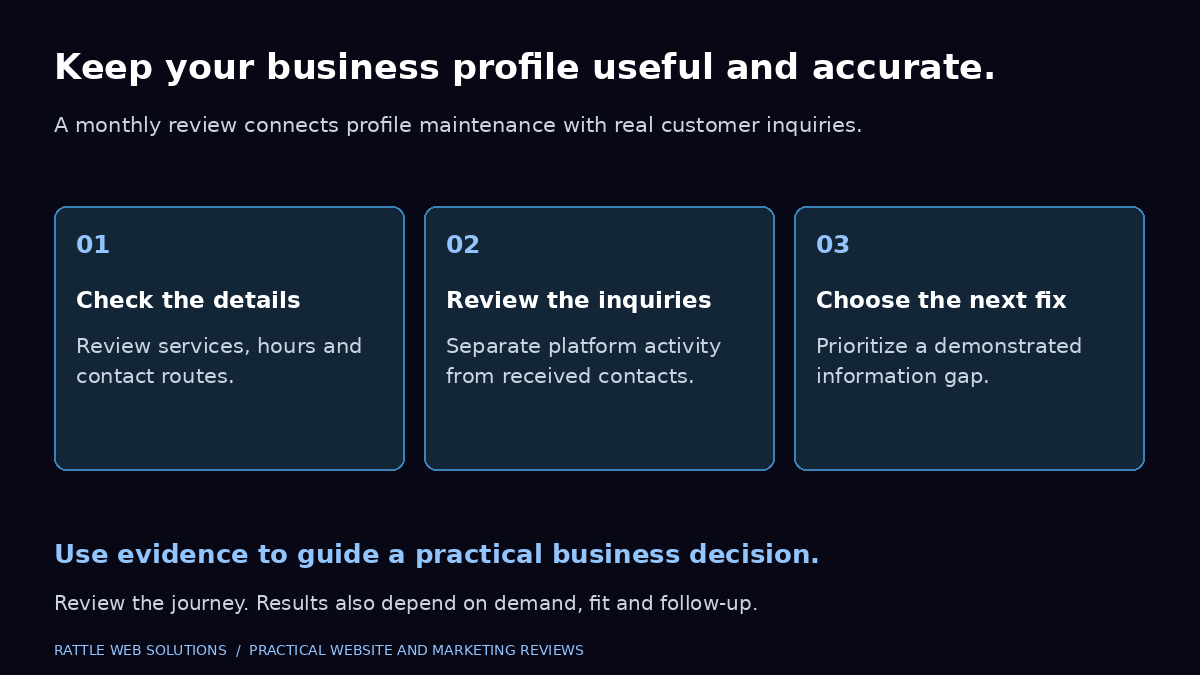
The monthly conversation does not need to become a tour of every dashboard chart. Use these questions:
- Is the business information still accurate?
- Which useful changes were made and why?
- What did customers search for or try to do?
- Which inquiries reached the business and were suitable?
- What problems did customers or staff report?
- What is the next specific change, and who owns it?
Keep an action list with a date and owner. If the business is slow to answer calls, adding more updates may not address the immediate loss. If callers repeatedly request an unavailable service, clarify how the business is represented. Let the evidence determine the next task.
When another service is the better priority
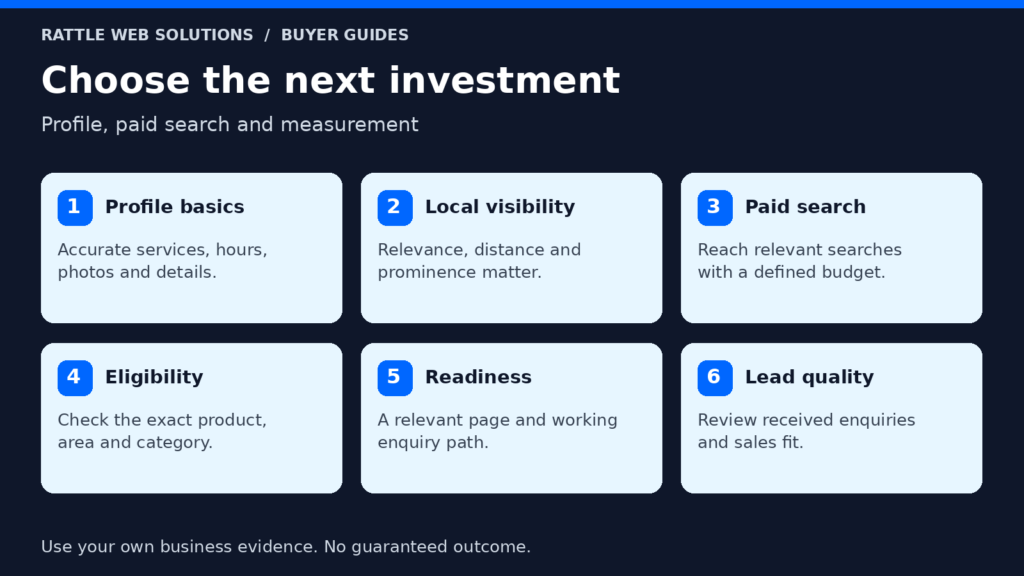
Profile management is not always the main bottleneck. If the profile is accurate but the website is confusing, the destination may need attention. If suitable inquiries arrive but nobody follows up, the operational process comes first. If broader search demand needs testing, paid search may be a separate option with its own budget and measurement.
Do not let a monthly package become the automatic answer to every local marketing problem. A good provider should be willing to explain when a different task deserves priority.
Rattle’s SK Party Hall case study shows one local business context and separates observed platform activity from venue reported outcomes. Use it to understand the approach, not to assume identical results for another business.
To work out whether your next step is setup, maintenance or a wider inquiry journey improvement, share your profile and current situation.
Questions before choosing a provider
Is posting every week enough to manage a profile?
No. Posting is one possible activity. Accuracy, service clarity, reviews, contact routes, ownership and useful performance review also need attention. The appropriate scope depends on the business.
Can an agency guarantee a top Maps position?
No. Google’s ranking factors include elements such as distance that a provider cannot control. Ask for a practical scope and evidence led review rather than a guaranteed position.
Does a direction request prove someone visited?
No. It records an action on the platform. Confirmed visits, bookings and revenue require additional business evidence. Keep those measures separate.
Is advertising spend included in profile management?
Only if the agreement explicitly includes it. Profile management, paid campaign management and advertising media are different costs. A proposal should make the total and exclusions clear.