If you run a service business, you do not need to become an analytics specialist to ask good questions. You need a shared definition of the outcomes that matter and a repeatable way to review them.
This guide provides a practical agenda, a compact reporting table and a method for deciding what to improve next. It works for local businesses and professional service firms, including businesses serving international clients remotely.
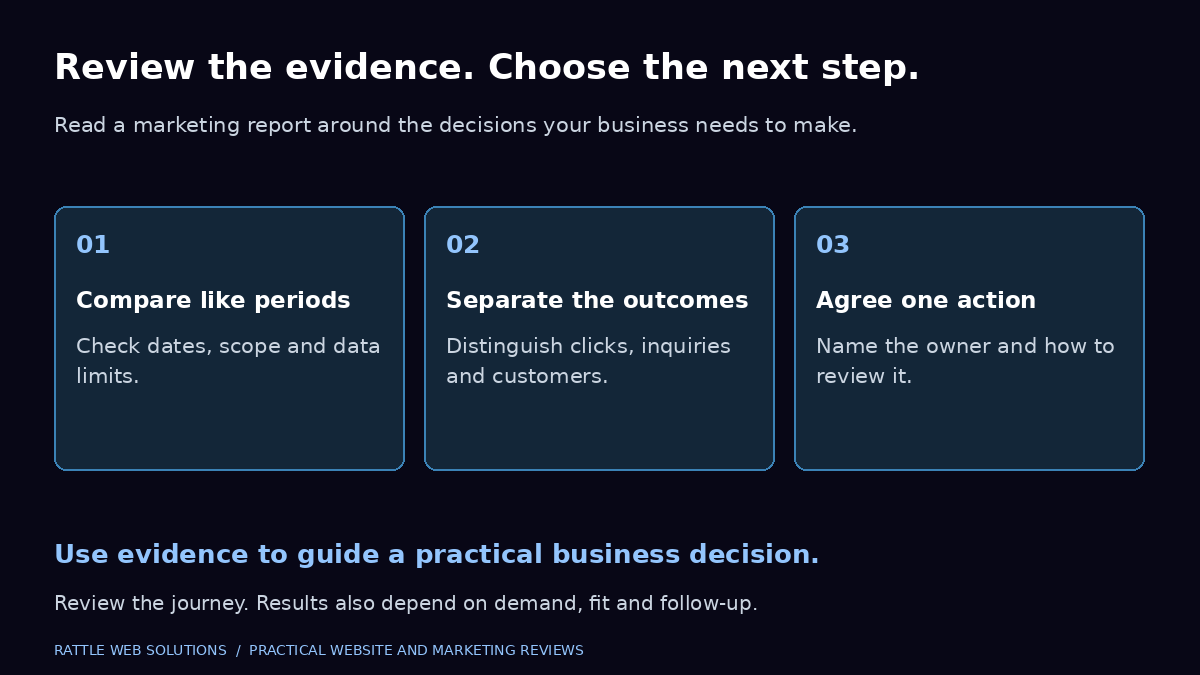
- Check the evidenceAgree what each metric actually records.
- Review business fitJoin sources to reviewed inquiries and sales.
- Choose the next actionSet one priority, an owner and a review condition.
Start with the business question
Before opening a dashboard, decide what the review needs to answer. “Is our marketing working?” is too broad to produce a useful decision on its own.
More specific questions include: are the inquiries suitable, which services are being requested, are prospects in the right locations, and what happens after the sales team responds? You may also need to know whether a new page is attracting the intended readers or whether advertising is reaching relevant searches.
Choose the period and the comparison carefully. A seven day operational check can catch broken forms or unusual spend. It may be too short to judge a service with a long buying cycle. A monthly review can show more context, while a quarterly view may help identify whether the overall acquisition mix is becoming more useful.
Use reporting windows that match your business. Do not treat an arbitrary calendar boundary as proof that the data is mature enough for a major decision.
Build one chain of evidence
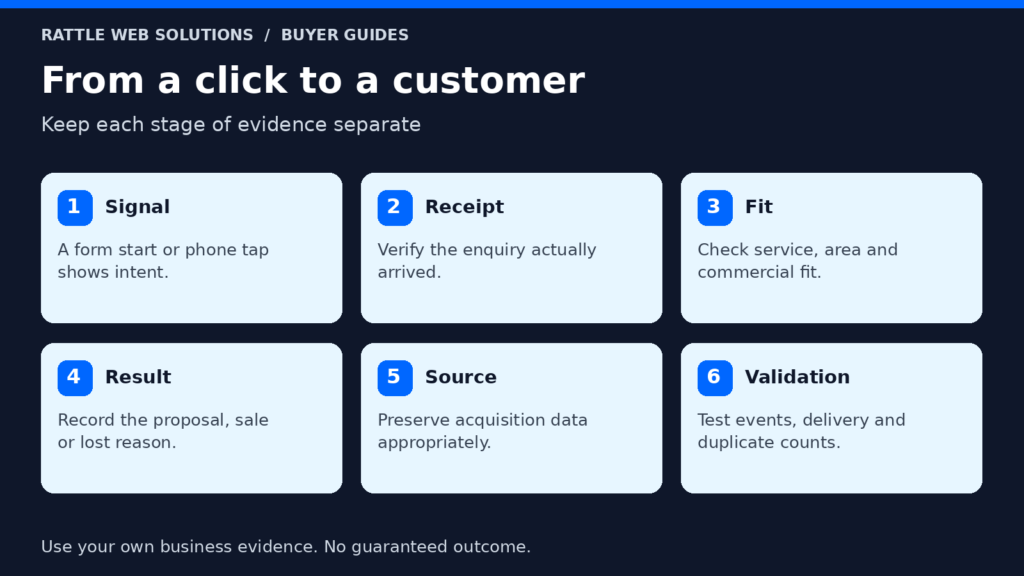
Visibility, traffic, contact actions, received inquiries, qualified leads and customers are related, but they are not interchangeable. Give each stage a clear meaning.
| Stage | Useful question | Typical evidence |
|---|---|---|
| Visibility | Are relevant buyers likely to encounter us? | Relevant search impressions and presence |
| Visits | Are the right people reaching useful pages? | Landing pages, source and geography |
| Contact actions | Are visitors attempting to get in touch? | Form starts, call taps and message clicks |
| Received inquiries | Did the business actually receive contact? | Accepted forms and confirmed conversations |
| Qualified leads | Do those contacts fit the agreed criteria? | Reviewed records with reasons |
| Opportunities | Is there a workable sales discussion? | Accepted discovery or proposal stage |
| Customers | Did the commercial outcome occur? | CRM or finance evidence |
This structure prevents a common misunderstanding: marketing reports more conversions while the owner sees no additional opportunities. The term conversion may be describing a click rather than a received, suitable inquiry.
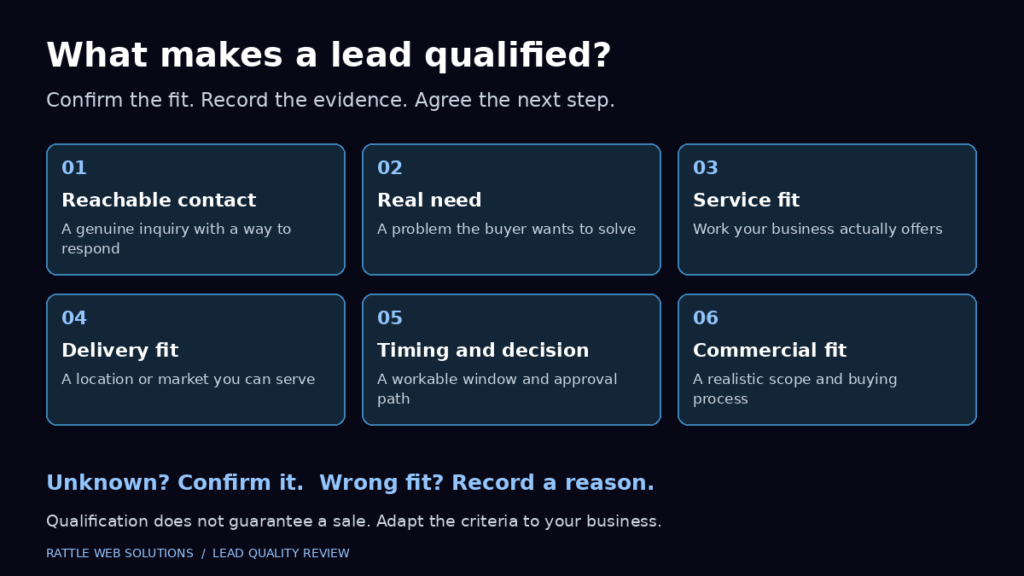
Agree the qualified lead definition before comparing channels. Otherwise one source can appear better simply because its leads are judged less strictly.
Check the quality of the data before judging the result
The first question is whether the report measures what it claims. Ask how form submissions are counted, what the phone metric represents, and whether duplicate contacts are removed from business reporting.
A thank you page view is not necessarily a new inquiry. Someone can revisit it or open it directly. A phone tap may not connect. A platform total may include a different date basis or attribution window from the CRM. These boundaries do not make the data useless, but they must be understood.
Google Analytics provides separate recommended lead events, including generation, qualification and conversion into a customer. Those events need appropriate implementation and context; their availability does not mean they are already collecting reliable outcomes on your site.
Ask for a short measurement note alongside the report: what is counted, where it comes from, what is excluded and what remains unverified. If the answer is uncertain, fixing measurement may be the next task before changing the marketing.
Read traffic through relevance
More traffic can be useful. It can also mean more visits from students, job seekers, vendors or people outside your delivery market.
Review the pages that attracted visitors, the available search queries, geography and sources. Then ask whether that mix matches the business you want. A US focused professional service provider should not judge success only from worldwide session growth.
Do not assume every visit from a target country is a qualified buyer. Location is one signal. Service intent, commercial fit and later contact matter too. Equally, do not reject an otherwise suitable international buyer merely because their first visit appears from another location.
For content, distinguish educational reach from buying relevance. A broad glossary article may attract many readers but few likely customers. A practical buying guide can attract fewer visits while supporting more useful conversations. The report should make room for both roles and explain why each article exists.
Review inquiries with sales, not only marketing
The person receiving leads often knows things the dashboard cannot show: callers asking for unavailable services, unrealistic expectations created by an ad, or prospects abandoning a conversation when they learn the real scope.
Bring a small, representative set of inquiry records to the review. Remove unnecessary personal information. Discuss the requested service, market, status and reason for qualification or rejection.
Use consistent reasons such as outside service area, wrong service, spam, not ready, commercial mismatch or unable to contact. “Bad lead” is too vague to guide a useful change. Some statuses should remain “needs confirmation” until the team has enough evidence.
Also distinguish lead quality from follow up quality. A suitable buyer who never received a response is not evidence of poor targeting. A delayed reply, unclear proposal or operational constraint may explain why an opportunity did not progress.
Compare channels on the same basis
Paid search, organic search, referrals and local profile activity can serve different roles. Compare them with consistent definitions rather than forcing every channel into the same immediate conversion expectation.
For paid activity, separate advertising media from agency management and relevant production costs. If you calculate cost per qualified lead, state which cost base is used. If you calculate customer acquisition cost, use a defined, consistent allocation rather than switching between media only and total marketing costs.
For organic content, account for the longer development and discovery cycle. A new article is not unsuccessful simply because it has no inquiry in its first week. It still needs a reason to exist, useful content, internal links and a review plan.
Attribution is also a boundary. A buyer may read an article, return through a brand search and then call. A last touch report does not prove that earlier content had no role. Treat attribution as one perspective and corroborate it with the business’s available evidence.
A compact report you can ask for
An owner friendly report can start with one page. Supporting charts can sit behind it.
| Reporting field | What a useful answer contains |
|---|---|
| Period and comparison | Dates, comparison basis and significant calendar effects |
| Relevant reach | Main buyer queries, markets or service interests |
| Useful visits | Important landing pages and relevant traffic mix |
| Inquiries received | Confirmed contact, duplicates and known gaps |
| Lead quality | Qualified, pending and disqualified counts with reasons |
| Sales progress | Opportunities and customers where evidence exists |
| Costs | Clearly defined media, management and other included costs |
| Changes | What was changed and why |
| Limitations | Missing data, delays and unverified measurement |
| Next action | One specific task, owner and review condition |
Do not populate missing fields with zeros. A zero says the measured outcome did not occur. “Not tracked” says you do not know. Confusing them can lead to the wrong decision.
Use a practical weekly review
A weekly check is primarily operational. Look for broken inquiry routes, unexplained spend changes, unsuitable requests, missing notifications and unanswered leads. Confirm that the team is applying the agreed statuses consistently.
Review unusual changes before reacting. A public holiday, reporting delay or one large referral can make a short period look very different. Record the observation and decide whether it needs immediate action or more evidence.
Do not redesign pages every week because a chart moved. The useful output might be a form repair, a targeting review, a clearer service exclusion or better follow up ownership.
Keep the meeting short and action based. If no new evidence requires a change, maintaining a stable approach can be the right decision.
Use the monthly review for priorities
The monthly review can connect the whole journey. Are the right markets discovering you? Are useful pages attracting relevant visitors? Are inquiries becoming opportunities? Which constraints keep appearing?
Choose one or two priorities based on the largest credible gap. If relevant traffic is limited, research and content may deserve attention. If suitable visitors do not understand the offer, improve the page. If leads arrive but are unsuitable, review intent, scope and qualification. If good opportunities stall, examine the sales process.
Rattle’s solution pages follow these different needs: Get Found Online, Turn Visits into Inquiries, Attract Better-Fit Leads, See Which Marketing Works and Grow Proven Lead Channels.
The purpose is to choose the right next intervention. Buying every service at once is not automatically a better strategy.
Write a hypothesis before changing the website
A useful hypothesis links evidence to a proposed change. For example: “Prospects repeatedly ask whether we serve their city, so we will make our service area clearer beside the main inquiry action.”
Record the change, the date, the expected effect and the review condition. The expected effect might be fewer unsuitable inquiries, a higher share of complete submissions or fewer repeated questions. Avoid promising a percentage improvement before testing.
Where traffic is small, a formal split test may not produce a reliable answer quickly. Use controlled before and after observation, sales feedback and usability checks, while acknowledging other changes. Do not call a small observational result a proven causal lift.
Prioritize changes that resolve a clear defect or misunderstanding before cosmetic experiments. A working form and an accurate offer usually matter more than testing two shades of the same button.
A hypothetical example: fewer inquiries, better fit
Imagine a business receives many requests for a low cost service it no longer offers. The marketing report looks healthy because all form submissions are counted equally. Sales spends time declining most of them.
The business clarifies the current service and starting scope, updates irrelevant advertising terms and records rejection reasons. Total inquiries may decrease. That does not automatically mean the change failed.
The review should examine the proportion of suitable leads, opportunities created, time spent on unsuitable requests and eventual customers. It should also confirm that the business did not accidentally exclude an important buyer group.
This is an illustrative scenario, not a Rattle client result. Its lesson is that a larger top line number can hide an unhealthy acquisition journey.
What to ask your agency in the next review
- Which numbers represent received contact rather than contact attempts?
- Which inquiries matched our agreed buyer criteria?
- What did sales learn from the rejected and pending leads?
- Which changes were made, and what evidence prompted them?
- What can the report not tell us yet?
- What is the next action, and when will we assess it?
An agency should be comfortable discussing uncertainty. “We do not yet have that data” can be a responsible answer when it leads to a practical measurement plan. Replacing uncertainty with impressive charts does not help the business.
Turn the report into a decision
The end of a review should be clear: maintain the approach, fix a defect, investigate a gap or test a specific improvement. Assign an owner and an appropriate date. Carry the decision into the next review so the team can learn from it.
If your reports show activity but do not connect it to suitable inquiries, start with the definitions and data path. See See Which Marketing Works or share your current reporting problem with Rattle.
Marketing report FAQs
Which numbers should a small service business review first?
Start with confirmed inquiries, their fit with your services and market, sales opportunities, customers and the costs used to acquire them. Use traffic and platform conversions to explain the journey. Record missing information as not tracked rather than zero.
Why can Google Ads conversions differ from the CRM lead count?
The two systems may count different actions, use different attribution windows or record them on different dates. A call tap is not the same as a confirmed conversation. Compare definitions, duplicates, date ranges and successful form receipt before treating either total as the business outcome.
Should cost per lead include the agency fee?
State the cost base every time. For example, an illustrative US$500 in ad spend divided by 10 confirmed inquiries is US$50 per inquiry from ad spend alone. If a US$300 management fee is also allocated to that period, the combined cost is US$80 per inquiry. These are calculation examples, not client results. Use the same basis when comparing periods or providers.
How often should I review marketing performance?
Use short operational checks to catch broken forms, unanswered leads and unusual spending. Review the full journey monthly, while allowing for your buying cycle and reporting delays. Low-volume data may need a longer period before it supports a major budget decision.
Can a good report prove there is demand for my service?
A report can show evidence of relevant searches, suitable inquiries and sales within its measurement limits. It cannot establish product or service-market fit from visits alone. Check whether buyers want the offer, whether acquisition economics work and whether your team can deliver and follow up.
Customers are the objective. A good report helps you make the next decision that moves the business closer to them.