Separate coverage from a physical location
Three arrangements often get mixed together. A business may have a staffed branch customers can visit. It may travel to customers within a service area. Or it may deliver a service remotely to clients in many markets.
Those arrangements need different explanations. A branch page can discuss visiting the premises. A service-area page should explain how the business reaches the customer. A remote-service page can discuss working hours, coordination and the delivery process without suggesting there is an office in every city.
Google Business Profile has its own eligibility and representation rules. A website location page does not establish eligibility for another profile. Google requires accurate business representation and restricts virtual-office listings in its business representation guidelines. Check the rules for the actual business arrangement before creating or changing a profile.
For example, an agency based in Bengaluru can work remotely with a US client without claiming to operate a staffed New York office. The useful information concerns time-zone coordination, scope, communication and how the work is reviewed.
Find the location-specific decision
Ask your team what changes when an inquiry comes from that area. Travel distance may affect scheduling. Certain services may be available only in part of a city. An on-site assessment might be required, while another area can be handled remotely.
Write down those differences before commissioning copy. If the team cannot identify any, one clear service page with a coverage section may answer the customer’s question adequately.
Useful differences can also appear in the buying process. A commercial cleaning company might serve particular building types in one district, while a training provider may offer on-site sessions subject to travel arrangements. An event venue with one physical site should usually explain how to visit that venue, rather than imply there is another hall in every neighbourhood.
Avoid converting assumptions into local expertise. If you have not delivered projects in an area, do not write that your team knows every street or has served hundreds of customers there. You can state the area you are prepared to serve and explain any conditions honestly.
Choose the smallest structure that answers the question
| Business situation | Useful starting structure |
|---|---|
| One service with consistent delivery across nearby areas | Main service page with a clear coverage section |
| Coverage rules differ across a few areas | Coverage hub with selected service-area pages |
| Several genuine staffed branches | Branch directory with distinct branch pages |
| Remote delivery across countries | Service pages with delivery and coordination guidance |
| New expansion with uncertain availability | Explain current coverage and invite a suitability check |
This is a planning framework, not a promise that a particular structure will rank. Decide how someone should find the information from the menu or service page. A page that can only be reached from a search engine is harder for the business to maintain and harder for visitors to understand in context.
Your coverage hub should make boundaries clear. Name the areas you actually serve, describe important conditions and link to pages with meaningful detail. The hub can also tell people what to do if they are outside the usual area.
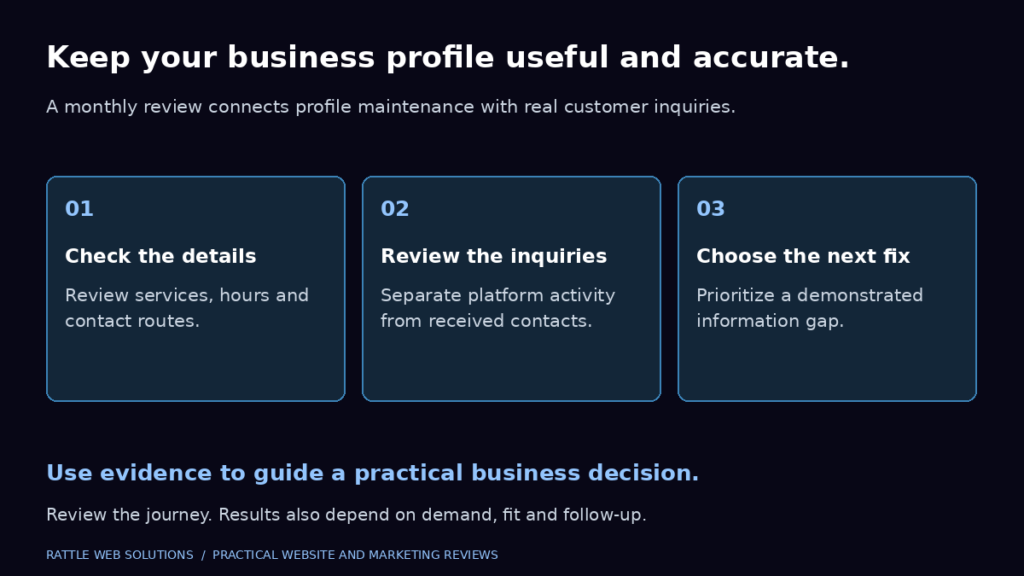
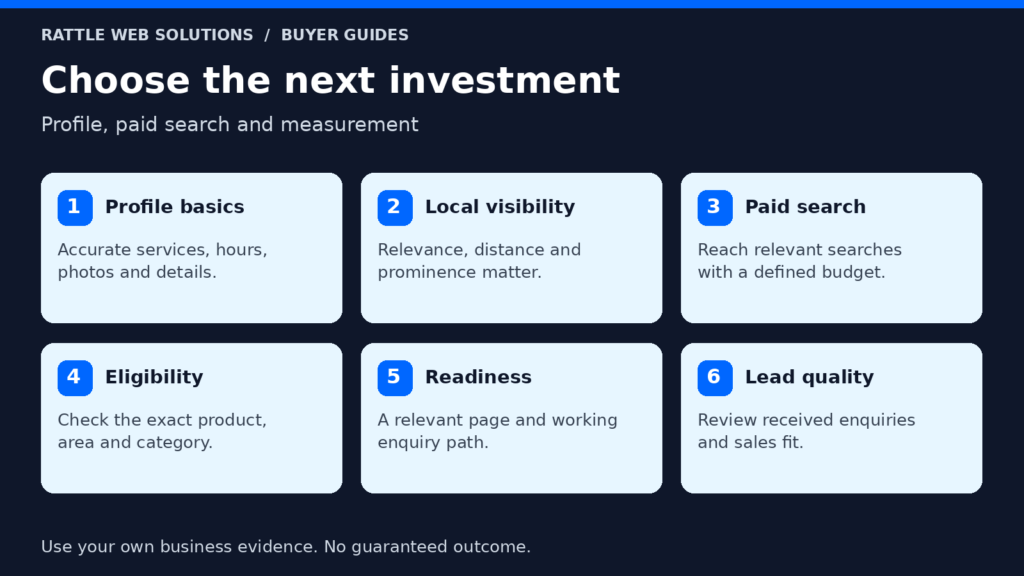
Our Google Business Profile management service considers how the profile, website and contact routes work together. Local visibility should lead to a realistic service conversation.
Understand the risk of near-identical pages
Google’s spam policies describe doorway abuse as similar search-targeted pages that send people towards more useful destinations, including regional or city pages used to funnel visitors to one page. See the current doorway-abuse policy.
The practical implication is to assess each proposed page as a destination in its own right. Could a visitor understand your service in that area, assess whether it fits and take a relevant next step without first finding a different page that finally explains the offer?
A shared inquiry form does not automatically make your location pages a poor experience. Many legitimate services use one contact process. The concern is the value of the intermediate page: is it there to help someone, or does it repeat a place name and postpone every useful answer?
There is no reliable percentage of rewritten copy that turns a weak page into a useful one. Replacing synonyms may change the words while leaving the customer’s uncertainty untouched. Distinct facts and a sensible place in the website matter more than a cosmetic uniqueness score.
Give a justified page enough useful detail
A service-area page should lead with the service available and the coverage arrangement. Explain whether you visit the customer, work remotely or ask them to attend a physical location. Do not make them infer it from a map image.
Follow with practical delivery information. State how an inquiry is assessed, whether a visit is needed, what affects availability and which details help you confirm fit. If travel or location can affect charges, explain how those charges are agreed without inventing a fixed price.
Add relevant evidence when you have permission to use it. A genuine project in the area can show the type of work performed and the circumstances. One relevant example with its limits is more credible than an unsupported claim to be the city’s leading provider.
You can include local questions your team has actually received. For an on-site service, people may ask about appointment windows, access requirements or neighbourhood coverage. For remote work, they may ask about calls outside their working day. Answer the questions the delivery model creates.
Finish with a contact action that carries the context. Ask for the service required and the customer’s location so the team can assess coverage. Avoid promising acceptance before you know whether the request fits.
Keep the language specific without forcing place names
The location belongs where it clarifies meaning: the title, opening explanation, coverage details and relevant questions. It does not need to appear in every sentence.
Read the draft aloud. Would you use this language in a conversation with someone who lives there? A paragraph packed with neighbourhood names can sound like a spreadsheet trying to introduce itself.
Use the business’s actual terminology. If customers describe their requirement by service type or property type, include that distinction. Do not invent local slang simply to make the page appear written by someone based in the area.
Avoid blanket superiority claims. “Available for scheduled on-site consultations in the listed areas” gives the customer usable information. “The number-one local expert everywhere” creates an expectation you may struggle to substantiate.
Photography and maps should also be honest. Label representative illustrations where needed. An image of a landmark should not imply an office or completed project. Original project photographs, used with permission, usually have a clearer relationship to the service.
Plan links around the customer’s next question
Connect each location page to the service it describes and to the coverage hub. A visitor should be able to understand both the offer and the geographical arrangement without using the browser’s back button as the main navigation system.
Link to a relevant case study when it supports the point. Do not force an unrelated story onto every area page just to increase the number of links. The same principle applies to blogs: a guide about choosing a service can be useful, while a distant topic creates another distraction.
Our SK Party Hall case study illustrates a local channel connected to calls, visits and customer outcomes for one venue. Its results relate to that engagement; they are not a forecast for another business or another area.
Keep URLs readable and stable. Choose a clear naming pattern when pages are created, then avoid changing it merely for a new keyword variation. If consolidation later requires a move, plan the old-to-new route deliberately so existing links still lead somewhere relevant.
Review existing pages before adding more
Create a simple inventory of current area pages. For each one, record the service, coverage promise, distinct information, evidence, contact route and maintenance owner. Then group pages that answer effectively the same question.
| Finding | Editorial decision to consider |
|---|---|
| Accurate page with distinct delivery information | Keep and improve clarity |
| Several pages with the same offer and little local detail | Consolidate into a useful coverage page |
| Page suggests an office that does not exist | Correct the representation |
| Area no longer served | Update availability and decide the relevant destination |
| Good local project with no explanation of current service | Add the delivery context |
Do not delete pages solely because they have limited traffic. A page may support a niche customer decision or a sales conversation. Review its usefulness, accuracy and role before deciding whether to retain it.
Likewise, do not preserve an inaccurate page solely because it once attracted visits. Customers need truthful information today. An old coverage promise can waste the customer’s time and the team’s follow-up effort.
If the inventory is large, start with the pages linked from your main service routes. Correct visible misrepresentation first, then address repetitive structures in manageable groups. Record what moved and why.
Measure suitable inquiries by area
Decide what success would mean for each location. A useful page should help the right people understand availability and contact you with enough context. Visits alone cannot show whether the request came from somewhere you can serve.
Ask your inquiry process to capture the customer’s location where it matters. Keep it proportionate: a city or postcode may be enough for an initial coverage check, without demanding a complete address before the person understands the service.
Review accepted and unsuitable inquiries separately. If a page produces many requests outside your coverage, the wording or targeting may need attention. If inquiries fit but scheduling is difficult, the issue may be capacity or operations rather than the page’s search performance.
Use our guide to reviewing a marketing report to keep those decisions grounded in business outcomes. A location page should contribute to a service route your team can actually deliver.
Make expansion a controlled choice
Before publishing for a new area, confirm capacity, delivery arrangements, response ownership and any location-dependent costs. A new page should represent a real business decision rather than create one by accident.
Choose a review point and list what you will check: relevant inquiries, coverage misunderstandings, scheduling, quality and the effort needed to serve customers. Do not promise that publishing a page will create a predictable pipeline by a fixed date.
An illustrative example: a maintenance company can serve three nearby districts with the same team and process. It starts with one coverage page. Later, one district requires a different appointment arrangement and has several approved project examples. That area may now justify a dedicated page. The website expands when the information becomes useful.
Another example: a remote consultant wants clients in several countries. The consultant can explain time-zone coordination and project delivery on the existing service page. Separate country pages would need a further customer-facing reason; a flag icon and a country name would not supply it.
This approach also reduces maintenance work. Every published claim needs an owner who can keep it current. A smaller accurate website can be more useful than a large set of promises nobody checks.
Questions service businesses ask
Should I create a page for every city I can serve?
Only when each page answers a distinct customer question. If the offer and delivery are consistent, a clear coverage section or hub may be sufficient. Start with useful differences rather than a city list.
Can multiple pages use the same contact form?
Yes. A shared inquiry process can be practical. Each page should still explain the relevant service and coverage so the visitor has enough information before using that form.
Does a location page let me create another Google Business Profile?
No. Profile eligibility depends on the real business arrangement and Google’s rules. A website page cannot turn a remote market or an unstaffed address into an eligible branch.
How long should a service-area page be?
Long enough to answer the decision clearly. There is no useful word-count substitute for accurate coverage, delivery details, evidence and a relevant contact route. Remove repetition that adds no information.
Should similar area pages be redirected immediately?
First review their accuracy, role and destination. Consolidation may be appropriate, but plan where existing visitors and links should go. Do not replace one confusing route with another.
Build coverage customers can understand
Local SEO begins with an honest answer to “Can you help me here?” Your website should make that answer easier to find, with enough practical detail to support a suitable inquiry.