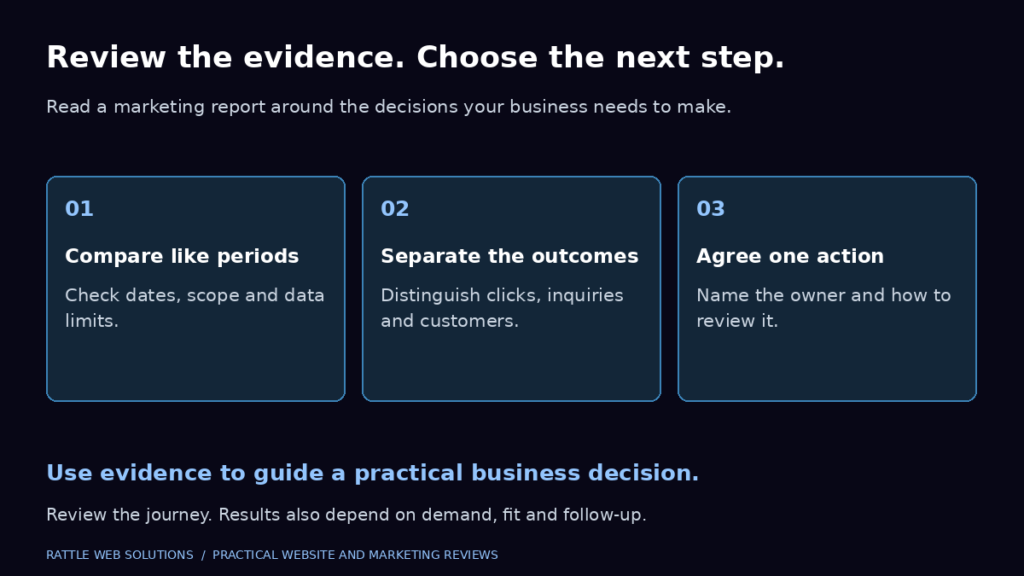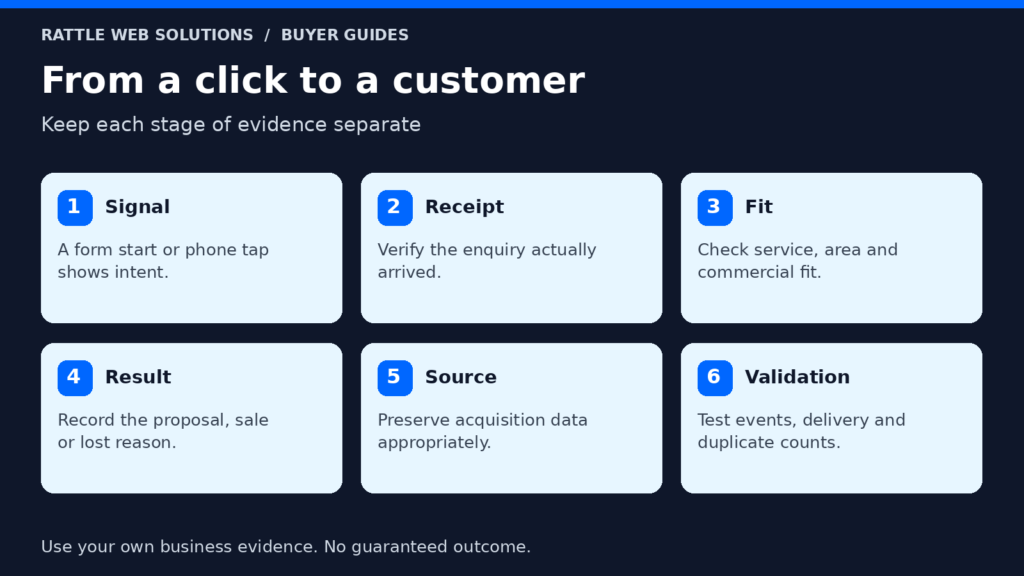
That definition sounds simple, but many service businesses use “lead” to describe several different things:
- Someone clicked the phone button.
- A form was submitted.
- A message reached the business.
- A real buyer requested an offered service.
- A sales conversation was accepted.
- A proposal was sent.
Those actions belong to different stages. When they are counted together, marketing may report success while sales says the leads are poor. Advertising can then optimize toward easy form fills instead of suitable customers. The solution is not a more impressive dashboard. It is one written qualification rule that marketing, sales and delivery teams apply consistently.
This guide gives a service business that rule, a six check review, clear disqualification reasons and a way to connect lead quality back to Google Ads, Google Business Profile, website content and sales follow up.
- ReceivedConfirm the business received a usable inquiry.
- QualifiedReview need, service, location and commercial fit.
- ProgressedRecord opportunities and customers separately.
A lead and a qualified lead are not the same
Google Analytics recommends generate_lead when someone submits a form or request for information. It separately recommends qualify_lead when a lead is marked as fitting the business’s criteria, and disqualify_lead when the lead does not fit.
Google Ads makes a similar distinction. It describes a qualified lead as a Google generated lead that has been qualified later in a CRM or internal lead system. A converted lead is a later chosen outcome, such as a closed sale or another completed sales step.
The important point is that the website usually records the contact action, while a person or business system confirms the fit.
| Stage | What has been proved | Example | Recommended owner |
|---|---|---|---|
| Contact action | Someone showed intent | Call tap, WhatsApp click, form start | Website analytics |
| Received inquiry | The business received a usable contact | Accepted form, connected call, confirmed booking | Form, phone or booking system |
| Valid lead | The contact is real and relevant enough to review | Genuine person or business asking about a service | Sales or lead operations |
| Qualified lead | The inquiry passes the written business criteria | Correct service, feasible location, real need and workable commercial path | Named lead owner |
| Opportunity | Both sides agree there may be a deal worth pursuing | Discovery call accepted, scope requested or deal created | Sales pipeline |
| Customer | The agreed commercial outcome occurred | Signed engagement, paid booking or closed sale | CRM, sales or finance system |
The precise labels can vary. The separation must not.
Why a form submission is not automatic qualification
A form can arrive successfully and still be:
- Spam.
- A job application.
- A vendor or partnership pitch.
- A student request.
- A request for a service the business does not provide.
- Outside the real service area.
- Too early, too small or otherwise unsuitable for the business model.
- Impossible to contact because the details are false or incomplete.
Calling every submission qualified inflates marketing reports and hides operational problems. Calling every imperfect inquiry unqualified creates a different problem: the team may reject a promising buyer merely because the first message is brief.
Qualification should therefore use a minimum evidence standard. Ask only for facts that change the decision. Record what is known, what still needs confirmation and why a lead is accepted or rejected.
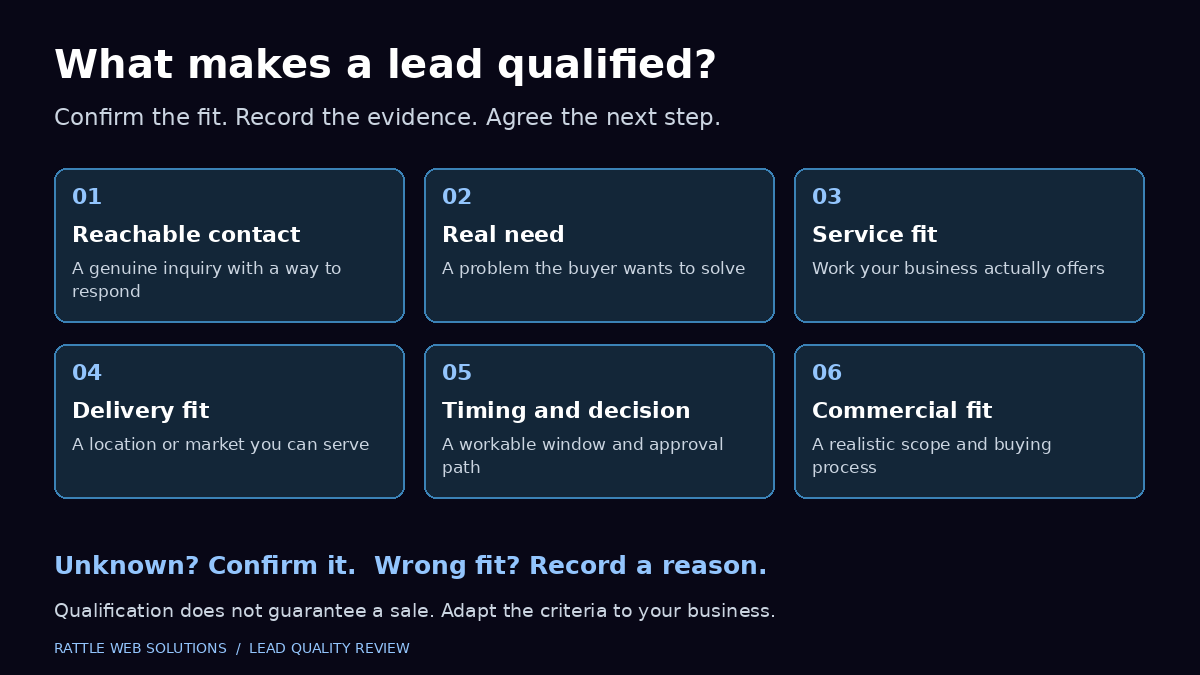
Use six checks to define a qualified lead
Rattle’s proposed qualification card uses six checks. A business can adapt the wording, but it should agree the rule before reporting or sending data back to an advertising platform.
1. Real identity and reachable contact
The contact should represent a real person or organization and provide a working way to continue the conversation. This does not mean collecting unnecessary personal data. It means confirming enough to distinguish a genuine inquiry from spam, a bot, an invalid number or a disposable message with no response path.
Evidence might include:
- A working business email or phone number.
- A company name or website where relevant.
- A connected call or response to follow up.
- A plausible explanation of the requested service.
Do not disqualify a consumer simply because they use a personal email address. Match the evidence to the service. A residential cleaner needs different identity information from a business to business Google Ads engagement.
2. Genuine need or problem
The lead should have a need the business can understand well enough to evaluate. “Please call me” may be a valid inquiry, but it is not yet proof of need. A quick follow up can establish whether the person wants the offered service and what outcome they are trying to achieve.
Useful questions include:
- What are you trying to change or solve?
- Which service are you considering?
- What is happening now?
- What would a useful next step look like?
The purpose is classification, not interrogation. Long forms can add friction and still fail to reveal whether the request is genuine.
3. Service fit
The requested work should fit an actual service and delivery capability. A WordPress agency may receive requests for mobile app development. A commercial cleaning company may receive a residential one off request. Both are real inquiries, but neither is automatically qualified for the offer being measured.
Define the acceptable service categories and common exclusions. Keep a separate “refer” status if the request is real but belongs with a trusted partner. That prevents referrals from being reported as bad leads while keeping them out of paid campaign optimization.
4. Location or delivery fit
The business must be able to serve the customer honestly and profitably.
For a local service business, this may mean an address inside a genuine service area. For a remote agency, it may mean a market the team can support across time zones, contracts, payments and communication. A United States inquiry is not automatically qualified merely because the business wants more United States clients.
Record the actual rule. Examples include:
- Within listed service cities or postal codes.
- Within a maximum travel boundary for an on site service.
- Remote delivery available in named countries.
- Excluded jurisdictions where the service cannot be supplied.
This protects the business from counting geography as quality without checking delivery feasibility.
5. Timing and decision path
A suitable buyer may not be ready today. Qualification should distinguish bad fit from bad timing.
The review should ask:
- Is there a real project or decision window?
- Who must approve the work?
- Is the contact gathering information, actively comparing providers or ready for a scoped conversation?
- Can the business follow up at an agreed date?
HubSpot’s default lead status options include stages such as New, Attempted to Contact, Connected, Bad Timing and Unqualified. That separation is useful. A valid future buyer with a known review date should not be mixed with spam or an impossible service request.
6. Commercial fit
Commercial fit means the possible engagement is compatible with how the business sells and delivers. It does not require demanding a budget number before answering a basic question. It does require enough information to decide whether a sensible path exists.
Criteria may include:
- Minimum viable scope.
- Expected buying process.
- Ability to pay through supported methods.
- Required delivery capacity.
- Contract, compliance or procurement constraints.
- Likely value compared with the cost to sell and serve.
Do not invent a budget on the buyer’s behalf. Mark commercial fit as unknown when it genuinely needs a conversation. A lead can be conditionally qualified pending that discussion.
Use the free lead qualification worksheet
Review a received inquiry against six checks, record what is unknown, and agree the next action. The two-page fillable PDF includes three fictional examples for service businesses in India and the US.
Download the qualification worksheet (PDF, 35 KB)
No email required. Download a copy and open it in a PDF reader that supports form fields, or print it. Keep completed copies private. A personal email address alone does not make a buyer unsuitable, and meeting the criteria does not guarantee a sale.
Need help understanding why your inquiries do not fit? Explore Attract Better-Fit Leads →
A practical qualification rule
A service business can use this starting rule:
Mark an inquiry as qualified when it is a genuine reachable contact with a real need for an offered service, a feasible location or delivery model, a workable decision window and a commercially plausible next step. Record any unknown criterion and the exact follow up needed to confirm it.
That rule is intentionally stricter than “submitted a form” and more flexible than “ready to buy now.” It creates three possible review outcomes:
- Qualified: the minimum criteria are met and a next sales action is appropriate.
- Needs confirmation: the inquiry may fit, but one or more necessary facts are unknown.
- Disqualified: a recorded reason proves that the inquiry should not enter the qualified lead count.
Avoid a single vague “not good” status. It cannot teach marketing or sales what to change.
Use specific disqualification reasons
Good reason codes make the data actionable.
| Reason | Meaning | Possible action |
|---|---|---|
| Spam or invalid | No genuine contact or request | Improve spam controls without blocking real users |
| Unreachable | Valid looking inquiry, but no working contact after the agreed attempt rule | Review form validation and follow up timing |
| Wrong service | Real request outside the offer | Clarify page copy, keywords and negative keywords |
| Outside delivery area | Business cannot serve the location or market | Tighten location language and campaign settings |
| Job or vendor inquiry | Contact has a different purpose | Route to a separate inbox or page |
| No current need | Interest exists but no real project or problem | Nurture only with consent; do not count as sales ready |
| Bad timing | Fit exists, but the decision window is later | Record the next review date |
| Commercial mismatch | Scope or buying conditions do not fit the model | Clarify minimum scope or package boundary |
| Duplicate | Same genuine inquiry already exists | Merge records and avoid double counting |
| Existing customer support | Request belongs to service delivery, not acquisition | Route to support and exclude from new lead reporting |
The reason codes should describe observed facts, not judgments about the person. Avoid labels such as “low quality” when the actual reason is outside area or wrong service.
Do not force every business into one universal score
A qualification score can help when the business receives enough inquiries to apply it consistently. It should not replace the minimum rule.
For example, a business might assign one point to each confirmed check: real identity, need, service fit, location fit, timing and commercial fit. A total can help sort follow up, but it creates several risks:
- Two critical failures can be hidden by four easy points.
- Staff may guess missing information to complete the score.
- Different services may need different thresholds.
- A high score does not prove the person will buy.
Treat essential criteria such as service and delivery fit as pass or fail conditions that a weighted score cannot cancel out. Use a score only for prioritization after those conditions pass. Keep an “unknown” value so absence of evidence is not silently treated as failure or success.
Three hypothetical examples
Example 1: qualified local service inquiry
A facilities manager asks a commercial cleaning company for recurring office cleaning at an address inside its service area. The company name and phone number are valid. The required schedule fits available capacity, and the manager can arrange a site assessment.
Classification: Qualified. The need, service, location, timing and next decision step are clear. Commercial terms still need a proposal, so this is not yet a customer.
Example 2: valid lead that needs confirmation
A business owner asks for help with Google Ads but gives only a name, email and “need more leads.” The contact is real, but the service scope, target market, website readiness and budget are unknown.
Classification: Needs confirmation. The inquiry should receive a prompt, useful response and a short discovery step. It should not be disqualified merely because the first form is brief, and it should not yet be reported as a fully qualified opportunity.
Example 3: real inquiry that is not a qualified acquisition lead
A job seeker submits the main contact form asking about vacancies. The message is genuine and deserves respectful routing, but it is not a request to buy a service.
Classification: Disqualified from the sales lead count with the reason “job inquiry.” Route it appropriately. Do not describe it as spam and do not send it back to Google Ads as a qualified lead.
Assign an owner and a response rule
A definition fails if nobody owns the decision.
Choose a named role responsible for reviewing new inquiries, applying the qualification card and recording the reason. The role may be the owner in a small business, a sales coordinator or a shared lead operations function. Set a response target that the team can actually maintain, and measure it from received inquiry to first meaningful response.
The reviewer should be able to see:
- Original source and landing page where available.
- Date and time received.
- Contact details and consent appropriate to the process.
- Requested service and message.
- Service area or delivery information.
- Qualification status, reason and reviewer.
- Next action and due date.
Do not put sensitive personal information into Google Analytics. Keep customer details in the appropriate form, CRM or business system, with access and retention rules suited to the business.
Connect the definition to HubSpot or another CRM
HubSpot distinguishes a Lead, Marketing Qualified Lead, Sales Qualified Lead, Opportunity and Customer, and allows lifecycle stages to be customized. Its default lead pipeline also includes New, Attempting, Connected, Qualified and Disqualified.
The software labels are useful only when the business defines the transition. For example:
- Lead: a valid received inquiry.
- Sales Qualified Lead: the six checks pass or the agreed minimum subset passes.
- Opportunity: a discovery, site visit, estimate or proposal process is accepted.
- Customer: the business records the chosen closed outcome.
Document who can change each stage and what evidence is required. If marketing calls a form submit qualified while sales requires a completed discovery call, reporting will remain inconsistent even inside the same CRM.
Feed lead quality back into marketing
Qualification is not only a sales task. The reason codes should change acquisition decisions.
Review lead quality by:
- Channel.
- Campaign and search term where available.
- Landing page.
- Service requested.
- Location or market.
- Device and contact method only when the sample is large enough to be useful.
- Valid, qualified, opportunity and customer outcome.
Examples of responsible action:
- Many wrong service leads may justify clearer page copy or negative keywords.
- Many outside area leads may justify better location language and campaign setting review.
- Many unreachable leads may justify form validation and response process changes.
- Qualified leads that never become opportunities may expose slow follow up, unclear scope or a sales handoff problem.
- Strong contact volume with no qualified outcomes should not be celebrated as growth.
Small samples are inconclusive. One poor inquiry does not prove a channel is broken. Look for repeated patterns, verify tracking and compare like periods before changing budgets or strategy.
Use qualified lead data carefully in Google Ads
Google Ads supports qualified lead and converted lead goals based on offline outcomes. Enhanced conversions for leads can connect first party lead data back to advertising interactions using Google’s supported process. Google currently recommends Data Manager for newer implementations and recommends qualified lead or converted lead goals for this use case.
Before using qualified lead data for bidding:
- Write the definition and reason codes.
- Train the reviewers and check agreement on sample inquiries.
- Confirm each status is recorded consistently and promptly.
- Verify identifiers, consent and data handling requirements.
- Test imports and diagnostics.
- Keep monitoring whether the data still represents the intended business outcome.
Do not import a status merely because a salesperson liked the lead. Do not label every form submission qualified to increase conversion volume. Automation amplifies the quality of the definition it receives, including its mistakes.
A weekly qualified lead review
Use a short operational review rather than a vanity dashboard.
| Question | Evidence |
|---|---|
| How many inquiries were actually received? | Form, phone, message and booking systems |
| How many were valid? | Reviewed contact records |
| How many passed the qualification rule? | CRM status and reason |
| Why were others disqualified? | Reason code distribution |
| How long did the first meaningful response take? | Received and response timestamps |
| Which sources produced qualified opportunities? | Source data joined to reviewed outcomes |
| Did any tracking or routing failure change the count? | QA and incident log |
| What one change is justified? | Repeated evidence, owner and acceptance check |
If the data cannot answer a question, mark it unavailable. Do not replace a missing CRM outcome with call clicks or contact page visits.
Frequently asked questions
Is every form submission a lead?
It can be counted as a submitted inquiry if the form was received, but it should not automatically be counted as a valid or qualified lead. Spam, job requests, wrong service inquiries and impossible locations need separate classification.
What is the difference between a marketing qualified lead and a sales qualified lead?
The exact definition belongs to the business. Commonly, marketing qualification indicates that a contact meets marketing agreed criteria and is ready for sales review, while sales qualification means the sales team has accepted the contact as a potential customer. Write the evidence required for each transition.
Should budget be required before a lead is qualified?
Not always. Some services require a budget range early; others need discovery before responsible pricing is possible. Commercial fit should be confirmed at the earliest sensible point without making the form unnecessarily intrusive.
Is a phone click a qualified lead?
No. A phone click shows intent. It does not prove that the call connected, involved a real potential customer or matched the service. Use call and CRM evidence for later stages.
What if important information is missing?
Use a “needs confirmation” status and record the exact question or action required. Do not guess. Do not reject a promising inquiry solely because a short first message lacks detail.
Who should decide whether a lead is qualified?
A named role with enough service and sales knowledge should own the decision. Marketing, sales and delivery leaders should agree the rule, but one role should apply it consistently and record the evidence.
When should qualified leads be imported into Google Ads?
Only after the definition, ownership, identifiers, privacy requirements, status timing and import diagnostics are reliable. The imported event should reflect a reviewed business outcome, not a duplicated form event.
Turn contact volume into a business signal
A qualified lead definition should help people make the same decision from the same evidence. It should protect advertising from weak signals, help sales prioritize follow up and show website teams which messages attract the wrong or right inquiries.
Rattle Web Solutions helps service businesses connect landing pages, Google Ads and lead measurement without treating clicks as customers. Review our lead tracking setup or explore our Google Ads management approach.