Competitor ads do not prove the channel is profitable, and a costly first set of clicks does not prove it is hopeless. The decision is a chain, not a platform verdict. If one link between a buyer’s query and a completed sale is missing, the campaign cannot supply the missing evidence on its own.
This guide provides a decision method. It does not promise a particular cost per lead, return or timeline. Those figures depend on the service, location, competition, sales process, customer value and quality of execution.
What Google Ads can and cannot do
Google Search ads can place a business in front of people who search for relevant words or phrases. That makes the channel useful when buyers already recognize a need and use Google to look for a provider, compare options or solve an urgent problem.
For example, a person searching for an emergency plumber, a commercial cleaning quote or help setting up conversion tracking is expressing clearer intent than someone casually reading a general business article. A carefully structured Search campaign can connect that demand with a relevant service page.
Google Ads cannot repair a weak offer, create unlimited demand or make an unresponsive sales process effective. It also cannot guarantee that every click comes from the perfect prospect. Location signals are not perfectly accurate, search language can be ambiguous, and some inquiries will not fit.
Treat paid search as a controlled acquisition system:
- Define the customer and service.
- Identify relevant search intent.
- Set a geographic boundary the business can genuinely serve.
- Send visitors to a useful, relevant page.
- Measure the steps from click to qualified opportunity and customer.
- Improve targeting, messages and pages using real outcome data.
If any of those parts is missing, increasing spend usually increases uncertainty as well as traffic.
The six link readiness model
- Query
Do buyers search for the service or problem you solve?
- Territory
Can you deliver well in the locations you target?
- Contribution
Can customer contribution support the full acquisition cost?
- Page
Does the page answer the request made in the ad?
- Proof
Can you verify receipt, qualification and sales outcomes?
- Response
Can the team respond, qualify and record what happens?
A weak link is a repair task—not a reason to increase spend. These checks guide a bounded test; they do not guarantee demand or profitable results.
1. Query: is there relevant search intent?
Start with the language a buyer would use, not an internal description of the service. A residential customer may search for a problem, such as “water heater leaking,” while a business buyer may search for a provider, such as “commercial HVAC maintenance company.” A marketing manager may search for an outcome or technical task, such as “track qualified leads from Google Ads.”
Create a small intent map with three groups:
- Direct service terms: the service and provider type
- Problem terms: the condition that causes someone to seek help
- Comparison terms: cost, alternatives, reviews, agency selection or best fit
Then separate buying intent from research that is unlikely to produce an inquiry. “Emergency electrician near me” and “how electricity works” may contain a related word but represent entirely different needs.
This first check is qualitative until reliable data is available. Google Keyword Planner, existing Search Console data, customer calls and an active campaign’s search terms can later improve the map. Never manufacture search volume to make a topic look attractive.
Paid search is usually a weaker first channel when buyers do not know the category exists, cannot describe their need, or require extensive education before they search for a solution. In that situation, useful content, referrals, partnerships or other forms of demand creation may need to support the campaign.
2. Territory: can the business serve the target locations well?
A campaign needs a truthful service boundary. That might be a radius around a real operating base, selected cities, a state, several states or an entire country for a service that can be delivered remotely.
Ask:
- Where can the team actually provide the service?
- Do travel time, licensing or delivery costs change by location?
- Are there locations the business should exclude?
- Can staff answer and fulfill inquiries in the buyer’s time zone?
- Does the landing page explain the real service area without implying a fake office?
Google’s location targeting guidance says it uses several signals and is a best effort, not a guarantee of perfect geographic accuracy. That is why location settings and actual location reports should be reviewed rather than assumed correct.
For a business pursuing United States clients from another country, the offer must be genuinely deliverable remotely. The website should state the service model clearly. It should not create invented American offices, addresses or local testimonials. Trust is better built through a clear process, relevant expertise, accessible communication and verifiable work.
3. Contribution: do the economics support paid acquisition?
The maximum affordable lead cost should come from business economics, not an online average.
Begin with five inputs:
- Average customer revenue: what the business receives from a typical new customer over the period being evaluated
- Direct delivery cost: labor, materials, fulfillment and other costs directly caused by serving that customer
- Customer contribution: revenue minus direct delivery cost
- Target acquisition cost: the amount the business is prepared to spend to win a customer while retaining an acceptable contribution
- Qualified lead close rate: the percentage of qualified leads that become customers
A simple planning relationship is:
Planning CPL ceiling = allowable customer acquisition cost × observed qualified lead to customer rate
Consider a purely hypothetical example. A service produces $2,000 in customer contribution. The business is prepared to use 20 percent of that contribution to acquire the customer, giving a target acquisition cost of $400. If one in four qualified leads becomes a customer, the planning ceiling would be:
$400 × 25 percent = $100 per qualified lead
This is not a benchmark or forecast. It is a decision model. The inputs should be replaced with the business’s own figures, and the result should include enough margin for missed calls, cancellations, delayed sales and variation in customer value.
The same exercise exposes a common reporting error: a form submission is not necessarily a qualified lead.
Use a simple outcome ladder:
- Contact action
- A form submission, phone call or other recorded action.
- Valid inquiry
- A real person asking about a relevant service.
- Qualified lead
- A valid inquiry that fits the service, area, timing and commercial criteria.
- Sales opportunity
- A qualified lead accepted for a proposal, appointment or serious sales conversation.
- Customer
- A completed sale or signed engagement.
Verify that an inquiry reached the business before assessing it. A contact click or a form success event alone does not establish receipt, qualification or a sale.
If a campaign optimizes only for the first stage, it may learn to produce cheap actions that never become customers. The business needs a way to pass later outcomes back into its analysis and, when appropriate, its advertising setup.
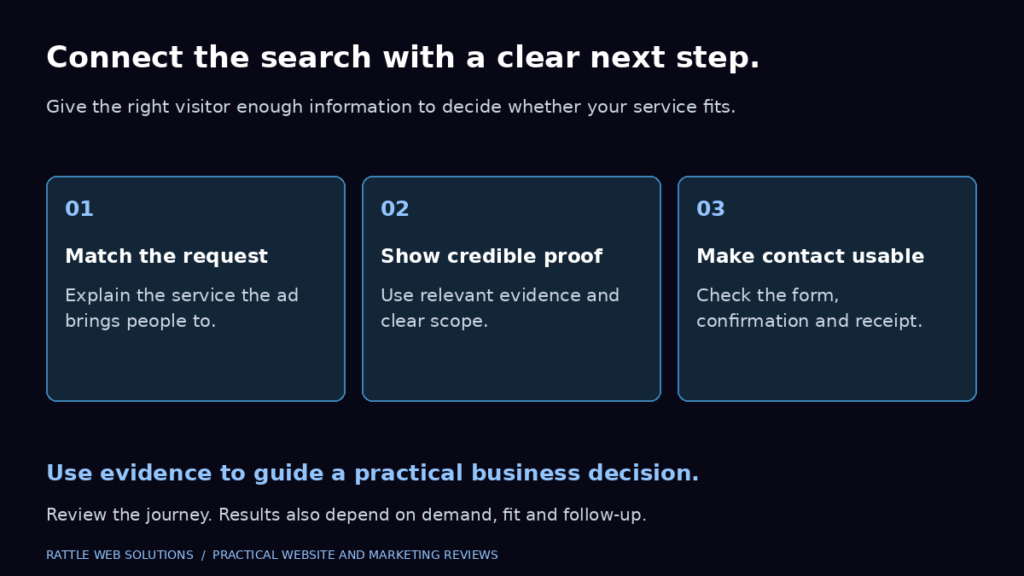
4. Page: is the landing page ready for paid traffic?
The best destination is usually the page that most closely matches the search and ad. Sending every visitor to the home page adds unnecessary work when a dedicated service page could answer the question directly.
A paid traffic landing page should make these points easy to understand:
- What service is offered
- Who it is for
- Which problems it addresses
- Where or how it is delivered
- Why the provider may be a sensible choice
- What evidence is available
- What the visitor should do next
- What happens after the inquiry
Google’s landing page guidance describes the experience in terms that include relevant and useful information, ease of navigation and whether the page meets expectations created by the ad. Message continuity matters. An ad about conversion tracking should lead to a page about conversion tracking setup, not a generic page that makes the visitor search again.
Before paying for clicks, test the page on a real phone and desktop browser:
- Does the page load without an error?
- Is the main heading visible and specific?
- Can a visitor understand the offer without decoding jargon?
- Is the call to action clear?
- Are tap targets usable and form fields labelled?
- Does the form show a genuine success state?
- Does a phone link work on mobile?
- Are privacy expectations explained where personal information is collected?
- Is there any unsupported claim, fake urgency or placeholder content?
If the site cannot support a relevant service page, it may be better to improve the WordPress website before increasing ad spend.
5. Proof: can the team measure qualified inquiries?
Google defines conversion tracking as a way to measure meaningful actions after an ad interaction. For a service business, useful actions may include a completed inquiry form, a qualified phone call, an appointment request or another validated contact method.
The basic measurement plan should answer:
- Which contact actions are tracked?
- Does tracking fire only after a successful action?
- Can duplicate events be detected?
- Can the team identify valid inquiries and spam?
- Who decides whether a lead is qualified?
- Can the source be carried into a CRM or lead record?
- Can later sales outcomes be connected to the original campaign?
- Are consent and personal data handled according to applicable requirements?
Google’s qualified and converted lead definitions distinguish later sales outcomes from an initial contact event. Current Google guidance also supports enhanced conversions for leads and recommends Google Ads Data Manager for supported offline lead workflows. The exact implementation depends on the site’s forms, analytics setup, consent requirements and CRM.
Rattle’s conversion tracking setup service is intended to connect website actions with clearer measurement. Delivery to a CRM and qualified outcome reporting still need independent testing for the actual site and workflow.
6. Response: can the sales process use the opportunity?
Technology proves that an action occurred. It cannot answer the phone, check fit, prepare a proposal or record why an opportunity was lost.
Define the operating response before launch:
- Who receives each type of inquiry?
- What response time is realistic during business hours?
- Which questions confirm service fit, territory, timing and budget?
- Where will the outcome be recorded?
- How will spam, existing customers and job applicants be separated?
- Who reviews missed calls and unworked leads?
A campaign should not be blamed for a suitable inquiry that was left unanswered. Equally, the advertising report should not count every long call as qualified when the sales record says otherwise. The ad account and sales record need a shared outcome language.
How much should a service business spend on Google Ads?
There is no responsible universal starting budget. A useful budget must consider expected click costs, the amount of relevant search demand, the value of a qualified lead, geographic scope, sales capacity and the amount of data required to make decisions.
Google Ads uses an average daily budget for many campaigns. Google’s budget guidance explains that, for most campaigns using an average daily budget, the daily billed limit is twice that budget and the monthly billed limit is 30.4 times it. That variation should be included in cash flow planning.
For example, a $100 average daily budget implies a typical monthly limit of $3,040 for the campaign under that rule. It does not mean the system will spend exactly $100 every day. It also says nothing about profitability.
Budget planning should separate:
- Advertising media spend paid to Google
- Campaign strategy and management fees
- Landing page or creative work
- Call tracking, analytics or CRM costs if applicable
- Sales follow up capacity
Rattle’s pricing page separates service fees from advertising media spend. The right media budget still depends on the business rather than a fixed agency package.
A small test can be useful if it is large enough to generate interpretable activity. A budget that produces only a few scattered clicks may not answer the viability question. At the other extreme, scaling before tracking and lead review are working can waste money quickly.
When should a service business delay Google Ads?
Delay or narrow the campaign when one or more of these conditions applies:
- The offer is unclear or changes for every prospect
- There is no evidence that buyers search for the service or problem
- The business cannot define a real service area
- Contribution margin and acceptable acquisition cost are unknown
- The website is broken, misleading or difficult to use on mobile
- Forms or calls cannot be measured reliably
- Nobody can review and respond to inquiries consistently
- The business lacks capacity to serve additional customers
- Advertising would rely on prohibited, unsupported or legally sensitive claims
Delay does not mean abandon. It means fix the missing condition and establish an acceptance check. For example, a form readiness task can pass when a test inquiry reaches the correct destination, generates one accurate success event and can be classified without exposing personal data. An offer clarity task can pass when a buyer can identify the service, audience, area and next step from the landing page.
A practical first campaign review cycle
Do not treat the first few days as a verdict. Use an initial review cycle to answer progressively better questions.
Before launch
- Confirm the service, locations and exclusions
- Define primary and negative intent themes
- Assign a relevant landing page
- Test calls, forms and success events
- Record the qualified lead definition
- Confirm budget limits and account access
During early delivery
- Check whether ads are serving in the intended locations
- Review actual search terms for relevance
- Add exclusions for clearly unsuitable searches
- Check that clicks reach the correct landing page
- Confirm conversion events are not missing or duplicated
- Review real inquiries, not only platform totals
After enough qualified outcomes exist
- Compare cost per valid inquiry and qualified lead
- Compare locations, services and intent groups
- Review sales opportunities and customers where the sample permits
- Improve the offer, page, ad or targeting based on the diagnosed gap
- Increase spend only when measurement and fulfillment can support it
Google’s search terms report shows queries that triggered ads and can help identify irrelevant searches for negative keywords. It is an operating control, not a one time setup task.
Google Ads or SEO: which should come first?
The channels solve different timing problems.
Google Ads can create immediate visibility for eligible searches once a campaign is approved and active, but traffic generally stops when spending stops. SEO builds discoverability through useful, indexable pages and usually needs more time and uncertainty before results can be assessed.
A service business may use paid search to test commercial messages and learn which queries lead to qualified conversations. It may use SEO to build durable service and educational coverage. The strongest decision is often not one channel versus the other, but which problem should be solved first and how learning will be shared.
If the website lacks a clear service page, fixing that page helps both channels. If no conversion measurement exists, installing it improves the quality of both paid and organic analysis.
Frequently asked questions
Is Google Ads good for a small service business?
It can be, especially when the business serves a defined area, buyers actively search for the service, and each new customer has enough value to support acquisition costs. Small businesses still need accurate targeting, a relevant page, reliable measurement and prompt follow up. Size alone does not determine suitability.
What is a good cost per lead?
A good cost per lead is one that supports profitable customer acquisition after lead quality and close rate are considered. Industry averages cannot replace your own contribution, target acquisition cost and qualified lead close rate. Measure valid and qualified leads separately from raw form submissions.
How long does it take to know whether Google Ads works?
There is no fixed number of days that proves success or failure. The time required depends on search demand, budget, conversion frequency, sales cycle and data quality. Review implementation immediately, search relevance during early delivery, and business outcomes only when enough comparable qualified leads exist. Mark small samples inconclusive.
Should ads send people to the home page?
Only when the home page is the most relevant answer. A focused service page is often better because it can continue the promise made in the ad, explain the service and give the visitor a clear next step. Google also treats landing page relevance and usefulness as parts of the advertising experience.
What should count as a conversion?
Count an action that represents meaningful progress, such as a successfully submitted service inquiry, a qualified phone call or an appointment request. Keep supporting actions, such as a button click, separate from primary outcomes unless the click itself proves completion. Record qualified leads and customers as later stages rather than assuming every contact became one.
Should phone calls be tracked?
Yes, if calls are a genuine inquiry path. Define which calls count, consider duration only as a supporting signal, protect personal information, and review whether calls concern the promoted service. A long call is not automatically a qualified lead.
Make the decision with your own evidence
Google Ads is most useful when it is connected to business economics, a clear service page and qualified lead outcomes. The six links in this guide turn a vague advertising question into specific decisions:
- Do buyer queries show relevant intent?
- Can the business truthfully serve the territory?
- Does customer contribution support acquisition cost?
- Does the page continue the promise in the ad?
- Can the team prove which inquiries are qualified?
- Can the sales process respond and record the outcome?
If the checks pass, start with controlled scope and explicit measurement. If they do not, fix the weakest dependency before buying more traffic.
Rattle Web Solutions provides Google Ads management, landing page support and conversion measurement for service businesses.
If your next task is turning relevant search traffic into conversations, explore Generate Inquiries. If inquiries already arrive but many are unsuitable, Improve Lead Quality explains the targeting and sales feedback to review.