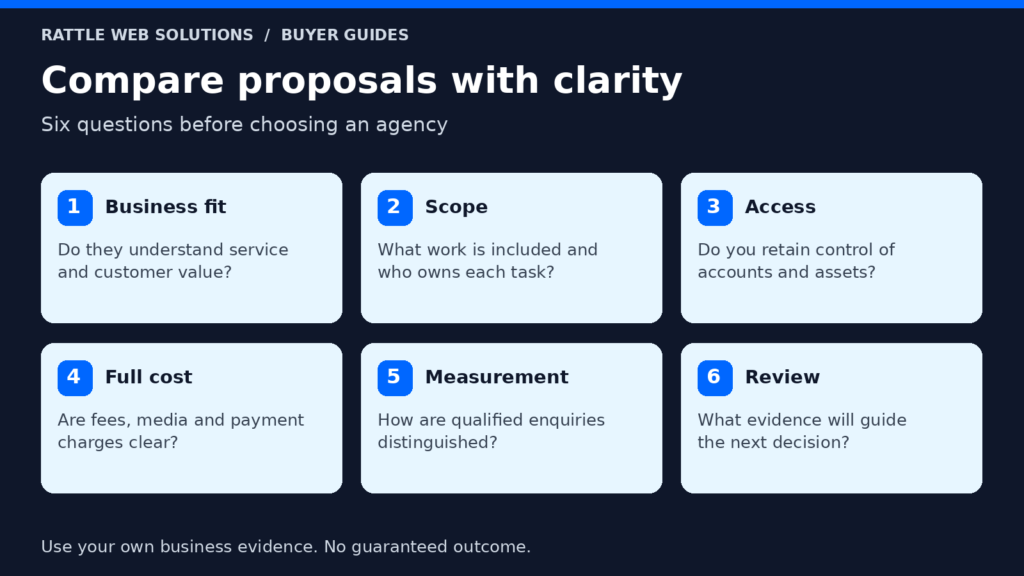
Begin with your own brief. Name the service you want to sell, locations you can genuinely serve, typical customer value, sales cycle, monthly media budget range and current response process. State which inquiries are poor fits. Without that context, two proposals may be describing completely different projects.
Ask what problem the agency is solving
An agency may offer account setup, campaign management, creative, landing pages, conversion tracking, CRM integration or reporting. These are related but distinct services. Ask what is included now, what is an optional project and which tasks remain with your team.
A useful discovery conversation should probe the complete route from query to customer. Does the agency ask about margins and capacity? Does it check whether the website page matches the service? Does it distinguish a phone tap from an answered, qualified call? Can it explain which assumptions need testing?
Be cautious of a proposal built solely from an estimated search volume and a promised lead count. Actual results depend on auctions, location settings, offer, landing page, competition and sales process. A responsible plan can set a bounded test and review criteria without inventing a guarantee.
Confirm account and asset ownership
Ask who owns and administers the Google Ads account. Ideally the business should have direct, durable access to its own account, billing, conversion settings and data, with the agency receiving appropriate manager access. Clarify ownership of the landing page, domain, analytics property, tag manager container, creative and any third party tracking number.
This matters at handover. If the provider leaves, can your team or a successor still inspect historical performance, understand conversion definitions, retain useful assets and remove the provider’s access? Ask for a written access map and a handover process.
Do not share a personal password by email or chat to create convenience. Use supported account access and permission controls. Review who has administrative rights and who can change billing or conversion goals.
Make the total price comparable
Get a written cost table in the currency you will actually pay:
| Cost | Question to ask |
|---|---|
| Advertising media | Is this billed directly by Google to the client? What budget and limits are proposed? |
| Setup | Which account, tracking, creative and landing page tasks are included? |
| Management | What is the recurring fee, review cadence and scope? |
| Production | Are copy, design, development, photography or CRM work separate? |
| Tools | Are call tracking, reporting or other third party subscriptions required? |
| Taxes and cross border payment | What will appear on the invoice and what conversion or processing charges apply? |
| Exit and handover | Is there a notice period or a charge for transferring assets and records? |
Compare the full client outlay, not just the management fee. A low quote can exclude essential tracking or landing page work; a higher one can include tasks you do not need. Ask the agency to state what happens when a location, service or campaign is added. Fees, exchange rates and payment providers change, so request an all inclusive written amount for the agreed scope rather than relying on a generic web price.
Rattle’s published USD service fees include standard payment processing and currency conversion costs, with no separate PayPal surcharge. Advertising spend is paid directly to Google and is additional. Applicable taxes, optional services and third party costs are itemized in the proposal, and the full payable total is agreed before work begins. Review the current pricing and payment terms and compare the complete agreed scope.
Define the measurement agreement before launch
Ask the provider to write a short event dictionary. Which event is a completed form? What proves it succeeded? How are calls and messaging actions classified? Which events appear as primary Google Ads conversions and which remain diagnostic? Who tests the event after form or site changes?
Google Ads supports reporting of qualified and converted leads as later stages in the lead process. That capability is useful only when the business can classify leads consistently, preserve attribution appropriately and meet applicable data requirements. Do not enable more data sharing simply to raise a platform score.
Use a sample lead log. Can the team connect a received inquiry to service, location, validity, qualification and outcome? Some attribution will remain uncertain, especially with calls, repeat visits and privacy choices. The report should make uncertainty visible instead of claiming every customer was caused by a click.
Ask about campaign structure and search terms
An agency should explain why it starts with particular services, locations, campaign types and landing pages. Ask how it reviews search terms, exclusions, geographic settings and irrelevant inquiries. For a small service business, a focused test may be easier to interpret than launching every service and territory on day one.
The provider should explain how it will react to a pattern. If many clicks are from job seekers, what changes? If calls come from outside the service area, what reports and settings will be checked? If qualified leads arrive but do not close, will it investigate the response or offer rather than merely increase budget?
Google’s advanced location settings can include people with interest in a target area, and targeting is based on imperfect signals. See Google’s location guidance. Ask the agency which option it chose and how it will review actual geographic performance. Do not assume the default is right for every business.
Inspect the landing page plan
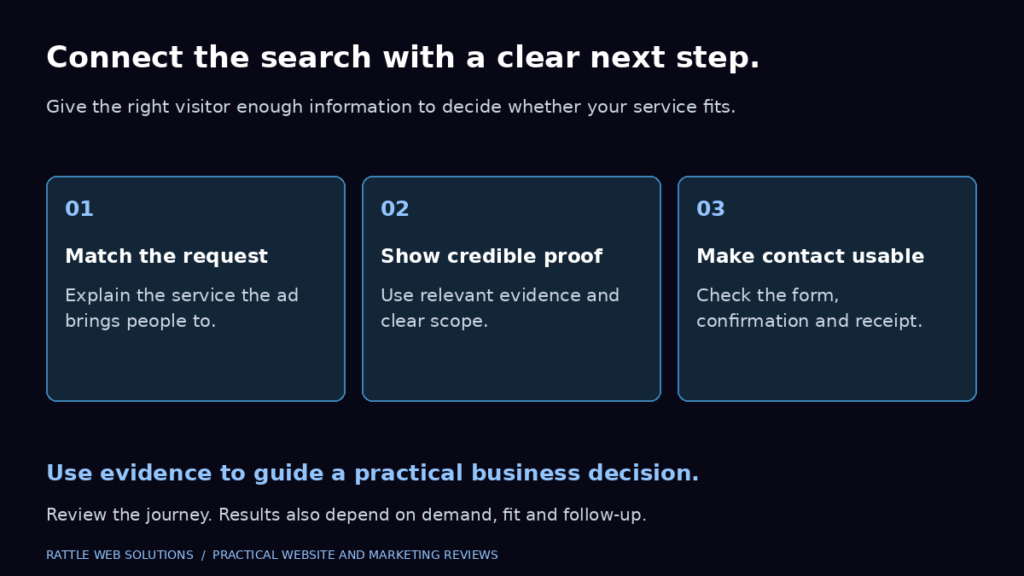
The page should continue the ad’s promise. If the ad offers a specific service in a location, the page should make that service, coverage and next step clear. Ask who will review the page on mobile, who fixes broken forms, and how the agency will test contact delivery.
Google describes landing page experience through relevance, usefulness, navigation and visitor expectations. See Google’s landing page guidance. A generic home page may be adequate for some branded searches, but it is rarely a complete answer for every service query.
Ask for the proposed CTA and the first response. “Book a call” should lead to a working calendar or contact process, not an unresolved button. A strong page also explains scope, evidence and what happens next without unsupported performance promises.
Compare reporting that leads to decisions
A monthly report should connect spend to useful stages: impressions and clicks as delivery diagnostics, valid inquiries as website outcomes, qualified leads as sales fit, and customers or revenue where the business can verify them. Avoid blending these into one “conversion” number.
Request a short narrative with each report:
- What changed in search terms, location, competition or landing page?
- What did the agency test and why?
- What happened to qualified lead volume and quality?
- What remains uncertain because of low data or incomplete CRM feedback?
- What decision is proposed for the next period?
The cadence should match volume. A week is useful for checking broken delivery and obvious waste. Fifteen days can reveal a pattern worth investigating. A month or longer may be needed for reliable qualified lead and sales trends, especially in a longer buying cycle. A responsible agency will not infer a stable return from a few clicks.
Check proof without accepting a universal promise
Ask for case studies relevant to your business model, but read them critically. What did the provider actually do? What was the starting point and reporting period? Which outcomes were directly observed, which were attributed, and what else changed? Can the provider show a client-approved result without exposing private data?
A result from another business does not establish your future cost per lead. The best proof may be a clear process, access transparency and a carefully scoped test rather than a dramatic headline. If a provider promises first place rankings, guaranteed sales or a fixed return without seeing your economics, ask for the evidence and terms in writing.
A practical comparison scorecard
Score each prospective provider from 0 to 2 on six dimensions: 0 for unclear, 1 for partial and 2 for a clear written answer.
| Dimension | What a clear answer includes |
|---|---|
| Business fit | Service, location, margins, capacity and sales process considered |
| Scope | Setup, management, landing page and tracking responsibilities defined |
| Ownership | Client access to accounts, data and assets, plus a handover path |
| Price | Full invoiced amount and separate media budget, with charges disclosed |
| Measurement | Completed inquiries, qualified leads and sales outcomes distinguished |
| Learning | Search term, location, page and lead quality review cadence |
The maximum is 12, but this is a discussion aid rather than a scientific ranking. A zero on ownership or fee transparency deserves an explicit resolution even if the total looks high. Ask each agency the same questions, then compare the written answers.
A proposal brief you can copy
Copy these fields into a document. Give each agency the same business facts, then ask it to complete the scope, cost, ownership and measurement fields in writing. Leave unknown business inputs marked “not yet verified” rather than guessing.
Service to promote:
Locations we can actually serve:
Ideal customer and poor-fit inquiries:
Customer value, margin and available capacity:
Monthly Google media budget:
Account, website and tracking starting point:
Included setup and recurring deliverables:
Full service invoice total, taxes and payment charges:
Additional media and third party budgets:
Client ownership and agency access:
Definition of received and qualified inquiries:
Response owner, reporting cadence and review criteria:
Handover, notice period and exclusions:
Compare proposals at the same media budget and service scope. If a total is unclear, resolve it before scoring the agency. A useful proposal explains both what the provider will do and what your team must supply.
Frequently asked questions
Should I choose a specialist or a full service agency?
Choose the provider that can cover your actual bottleneck and coordinate dependencies. If tracking and landing pages are weak, campaign management alone may not solve the problem. If those foundations already work, paying for a large rebuild may be unnecessary.
Should the agency guarantee a number of leads?
Be skeptical of guarantees that do not define validity, qualification, budget, location and time period. A provider can commit to a scope, cadence and quality checks. Commercial outcomes depend on factors beyond a campaign manager’s control.
Is a percentage of ad spend fee bad?
Not automatically. Compare incentives and total cost at your intended budget. Ask what happens when spend increases and whether that increase is tied to qualified results. A fixed fee can also be poor value if scope and accountability are vague.
How long should an initial test run?
Agree a bounded budget and review points before launch. Allow enough time for delivery, lead follow-up and meaningful outcomes, while checking technical failures immediately. The appropriate duration depends on search volume and sales cycle; there is no universal number of days.
What happens if I change agencies?
The business should be able to keep its account and appropriate assets, export useful records, review tracking definitions and revoke access through normal controls. Verify the contract and account setup before signing.
Choose clarity you can operate
An agency should make it easier to see what is being bought, who owns it, how inquiries are measured and what the next decision will be. The strongest proposal may be the one that names a weakness to fix before raising spend.
Rattle Web Solutions offers Google Ads management, conversion tracking setup and website support. To compare a concrete scope, request a lead generation plan and ask for the full cost, access map and measurement definitions in writing.
Not sure the business is ready for a provider yet? Start with the Google Ads readiness guide for service businesses before comparing proposals.
When comparing providers, use See Which Marketing Works to frame questions about reporting and customer outcomes. For an established channel, Grow Proven Lead Channels sets out the economics and capacity to review before expansion.