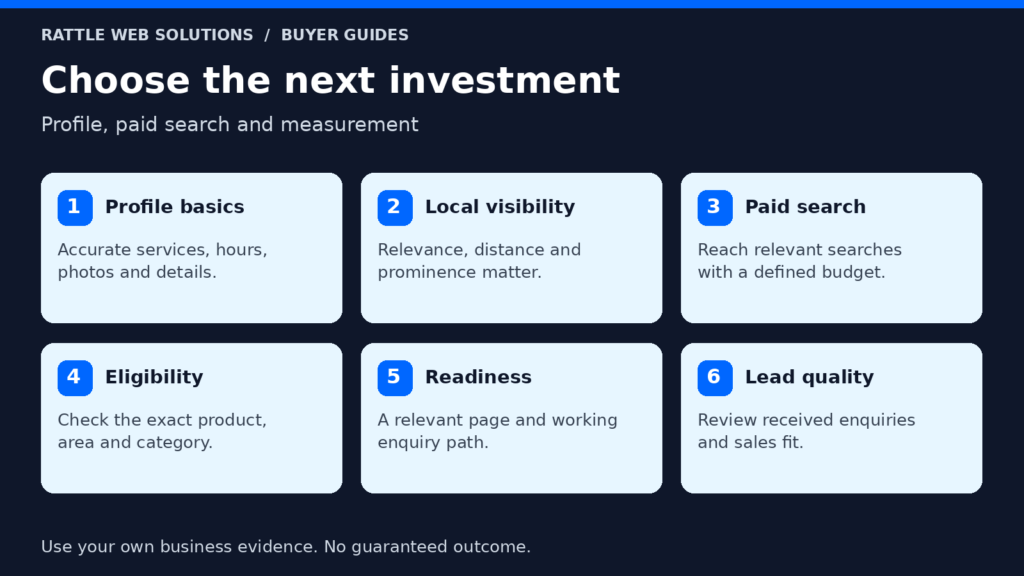
Google Business Profile helps eligible businesses appear and communicate in local Search and Maps experiences. Google Ads buys eligible placements for chosen campaigns, subject to auctions, settings and budget. Neither channel guarantees a new customer. Treat the choice as a resource decision: which investment is most likely to reveal a useful, measurable next step?
At a glance: Correct inaccurate profile details first. Test paid search when there is real demand for a specific service, a competitive offer, workable acquisition costs and a team ready to respond. Websites and ads help buyers find and evaluate you; they do not establish product or service-market fit on their own.
Start with the customer journey
Imagine a homeowner who needs an electrician this week. They may search for a nearby provider, compare opening hours, read reviews, visit a website and call. Another person may search for a very specific service and click a Search ad before ever opening Maps. Both journeys can lead to an inquiry. They need different preparation.
For many local businesses, a profile is part of the basic information layer. A wrong phone number, outdated hours or unclear service area creates friction for people who already know the business. A campaign can bring more visitors, but it cannot repair inaccurate business information. Likewise, a polished profile cannot necessarily create enough demand in every service category or location.
Map the journey for one service and one location first. What does the customer search? Is the request urgent or considered? Do people need to visit a physical location, or does a team travel to them? Which action should follow: call, booking, form or directions? Write those answers before choosing a channel.
What Google Business Profile can contribute
An eligible, verified profile can show practical details such as services, hours, contact options, photos and reviews in Google surfaces. Google says local results are mainly based on relevance, distance and prominence. Accurate and complete information helps customers understand the business; there is no way to pay Google for a better local ranking through the profile itself. See Google’s local ranking guidance.
For a service business, a first profile pass should answer:
- Is the business eligible for a profile and is the location or service area represented truthfully?
- Are the primary category, services, hours, phone and website accurate?
- Are photos real, current and useful to a buyer?
- Can the team respond to reviews and questions without promising outcomes it cannot deliver?
- Does the linked website page explain the service and provide a working inquiry route?
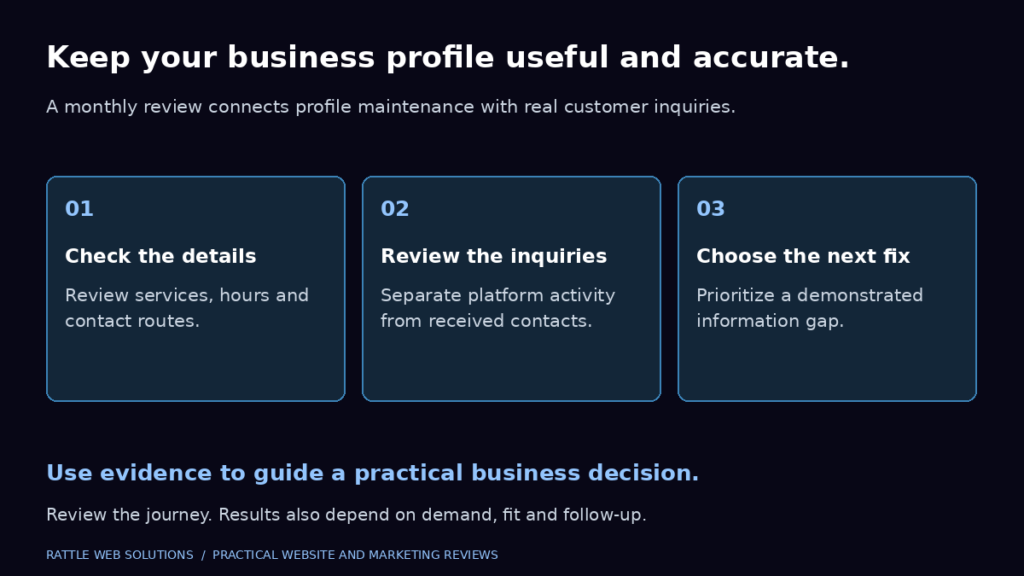
Profile work is ongoing. Changes in the business, opening hours and offerings need maintenance. Reviews should reflect real customer experiences, and business owners should retain appropriate ownership and access. A profile alone is not a complete lead system: calls need to be answered and inquiries need to be recorded.
What Google Ads can contribute
Google Ads can help a business test specific search intent and locations more directly. A Search campaign can match selected service terms with an ad and a relevant landing page. The business controls a budget, but actual delivery and results vary with auctions, competition, targeting, ad quality and the customer journey.
Paid traffic is more useful when the business already knows:
- Which services it wants to sell and where it can deliver them.
- What a qualified inquiry and a profitable customer are worth.
- Which page addresses the searcher’s request.
- Which completed action will count as a primary conversion.
- Who responds to the lead and records the outcome.
Google’s location targeting is an approximation based on signals, and its default advanced option can include people who show interest in a location. Review actual location settings and geographic reports rather than assuming every impression comes from someone physically inside the intended area. See Google’s location targeting guidance.
Ads also involve two distinct costs: media paid to the platform and any management or production fee paid to a provider. A proposal should describe both, along with the scope and any payment or currency charges, so the client can compare the total commitment. Rattle’s current pricing page is the place to check the published offer; ask for a written scope before committing.
Example: choosing the next step for a US local service business
Consider a hypothetical plumbing business with one operating base and a defined service area around Charlotte. Its team can handle more weekday repair work, but its profile lists outdated hours and the website combines repairs, installations and commercial projects on one generic page. This is a decision example, not a reported client result.
First, correct the profile’s factual details and confirm eligibility. Then create a clear repair page with the actual service area, proof the business can substantiate and a working call or inquiry path. If relevant search demand exists and customer economics support acquisition, test Search Ads for that one service rather than paying to promote every job type at once. Review received inquiries, service-area fit and technician capacity before expanding.
For eligible businesses, Local Services Ads may be another option. It has different onboarding, category and geographic requirements from ordinary Search Ads; check Google’s current eligibility guidance. Google also documents a phased 2026 migration of selected US providers to Performance Max campaigns with pay-per-lead goals. Check the actual account and category before deciding which product to use. This product note was reviewed on 1 October 2026.
A decision table for the first investment
| Situation | Better first action | Why |
|---|---|---|
| The profile has inaccurate contact details or hours | Repair the profile and linked page | Existing demand may be lost before a campaign adds traffic |
| The business has an eligible profile but little evidence of which service is wanted | Research one service and location, then test a small scope | A broad campaign would hide the actual question |
| The team cannot answer or qualify inquiries | Fix response and recording | More contacts will not necessarily become customers |
| One profitable service has clear search demand and a relevant page | Consider a controlled Search Ads test | Paid search can test a specific buyer intent |
| The business needs sustained local discovery across services | Maintain the profile, website and relevant content | Local visibility is a continuing asset, not a single launch |
| The service area is broad or the buyer is outside the immediate locality | Review the channel and targeting mix | A nearby map result may not match the actual buyer journey |
The table is a starting point, not a universal rule. A new emergency service with strong operations may justify paid testing early. A small business with a strong referral base may gain more from correcting its profile and website first. The decision changes when the data changes.
The most common false choice
“Free Maps or paid Ads” is too simple. Profile management takes time, photographs, business information, review handling and website maintenance. Ads can generate learning faster for a narrowly defined question, but they require budget and careful measurement. A service business may need both, in sequence or together.
The two channels can also expose each other’s weaknesses. If an ad brings a qualified visitor to a vague page, the page needs work. If the profile gets calls that are outside the service area, the service description or customer expectation may need work. If inquiries are plentiful but appointments are rare, the bottleneck may be qualification or response, not visibility.
Do not combine every interaction into a single “lead” count. A profile view, directions request, website click, phone tap, completed form, qualified call and paying customer are different stages. A phone tap does not prove a conversation occurred. Record each stage at the level that can actually be verified.
A practical 30 day review
Week 1: establish facts. Confirm profile eligibility and ownership. Correct core information. Pick one service and geographic area. Check that the linked page works on a phone, the contact route reaches the team and the business can fulfill the request.
Week 2: define the evidence. List the customer’s likely search terms and questions. Decide which website submissions, calls or bookings can be validated. Create a simple lead log with date, service, location, source where known, qualification and outcome.
Week 3: choose a bounded test. If the profile is inaccurate, finish that foundation. If search intent, economics and measurement are ready, consider a focused Ads test with a clearly stated media budget and management scope. Avoid expanding services and territories all at once.
Week 4: review quality. Compare valid and qualified inquiries with the time and money spent. Inspect search terms, locations and landing page behavior where available. Ask whether the next step is to improve the page, tighten targeting, respond faster or invest in the profile and content.
Thirty days can establish whether the system is functioning; it does not guarantee statistical certainty or a profitable campaign. Low volume may require a longer, deliberately bounded test. Stop or revise when the evidence shows an avoidable problem rather than spending blindly.
Questions local business owners ask
Can I run Google Ads without a Google Business Profile?
In some circumstances, yes. A business can run eligible Search campaigns to a website without relying on a local profile, subject to account and policy requirements. But inaccurate public business details still undermine trust. Check what the customer sees before buying more visits.
Will paying for Ads improve my organic Maps position?
Do not treat ad spend as a payment for local ranking. Google describes local ranking through relevance, distance and prominence. Ads are a separate paid channel. Measure paid and organic inquiries separately where possible.
Should I send Ads traffic to my profile or my website?
Choose a destination appropriate to the campaign format and customer task. For a website landing page, the promised service, location, proof and contact action should be easy to find. Test on mobile. Google describes landing page experience in terms of usefulness, relevance, navigation and the expectations set by the ad. See Google’s landing page guidance.
What if I serve customers across multiple cities?
Define actual service coverage, response capacity and margins by city. Represent locations truthfully in the profile and pages, then review paid targeting settings and geographic performance. Do not create fictitious offices or duplicate location pages just to appear local.
Which channel produces better leads?
The answer depends on service and execution. Compare qualified inquiries and customers, not just clicks or profile interactions. Preserve a source field where possible, while accepting that attribution will never capture every journey perfectly.
Choose the next test, not a forever channel
For most local service businesses, begin by making the profile and contact path trustworthy. Then decide whether a focused Google Ads test can answer a commercially useful question. Review the full journey from search to sale, and adjust the next investment based on qualified outcomes.
Rattle Web Solutions supports Google Business Profile management, Google Ads management and conversion tracking. If you want help deciding the order for your service and territory, request a lead generation plan. Bring your service area, current inquiry sources and response process so the discussion can start with facts.
Before paying for traffic, use the six Google Ads readiness checks to assess demand, economics, the landing page and response process.
If customers struggle to find and assess your services, start with Build Online Presence. If you are already discoverable and need a clearer route from interest to contact, explore Generate Inquiries.