More attention is useful only when it helps the right people understand your offer. Before changing your B2B content, assess who needs it, what they need to decide and where they go next. A content plan that suits one business may be wrong for another.
Start with a buying situation
Choose one service and one buyer question. A founder comparing providers needs different information from an operations manager checking delivery requirements. Write down the buying trigger, the people involved and the objection that could stop progress. Treat these as working assumptions until conversations or inquiry records support them.
Use this message review
- Problem: can the intended reader recognize the situation without decoding jargon?
- Offer: does the content explain what you actually deliver and where the scope ends?
- Evidence: can every client story, quotation and result be traced to an approved source?
- Next step: does the reader know whether to explore a service, review a case study or discuss their requirements?
For example, a hypothetical software provider could explain what a delivery handoff involves instead of claiming to eliminate every shipping problem. Label illustrative examples clearly; they are explanations, not client results.
Match the format to the question
Use a short explanation for a simple objection, a process diagram for a confusing handoff or a detailed guide when a decision needs context. Humor can suit some brands, but it should help the reader rather than obscure the offer. There is no requirement to chase a viral format.
Measure what you can actually observe
Copy this scorecard for one article and one fixed review period. Record the URL, dates, target buyer and source beside each entry. Use “unavailable” when a source cannot answer the question.
- Reach: record impressions in Search Console or the publishing platform. This shows exposure, not whether the right buyer read the page.
- Relevant visits: record clicks or landing visits and the available query, location and referral context. Treat buyer relevance as an assessment; analytics alone cannot identify every visitor’s role.
- Useful engagement: note service-link clicks or resource use where tracking exists. These indicate an action, not a received inquiry.
- Received inquiries: count genuine messages actually received in your inbox or CRM. Separate tests, spam and duplicates; phone or WhatsApp clicks alone do not establish a conversation.
- Qualified opportunities: record your team’s assessment of service fit, location, scope and next step. Attribute an opportunity to this article only when the evidence supports that connection.
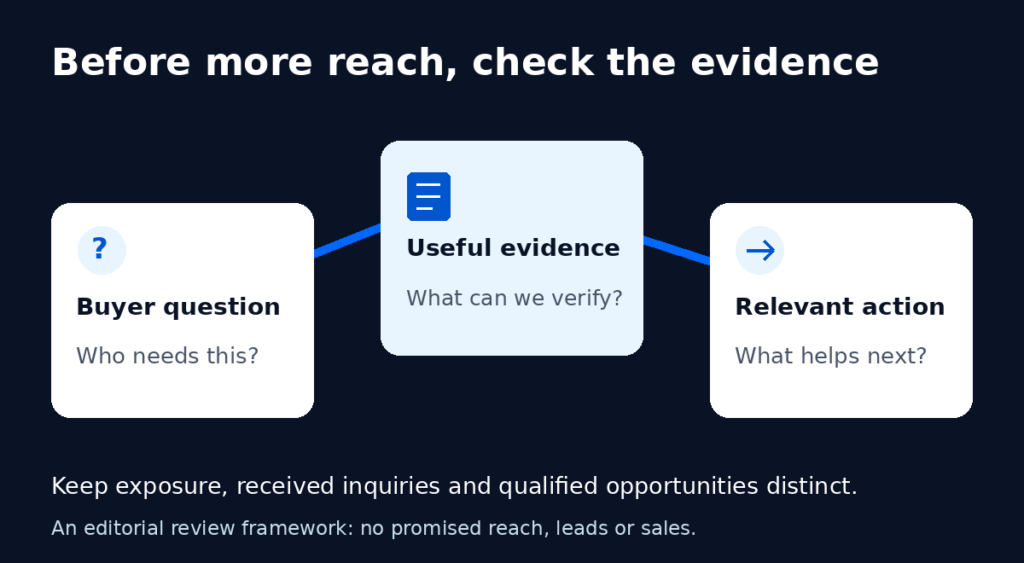
Do not divide figures from different sources into a conversion rate unless the people, definitions and dates can be matched. If reach is visible but the next stages are unknown, fix measurement first. If received inquiries repeatedly miss your scope, review the message and service fit before pursuing more reach. Small samples support questions to investigate, not proof that the article caused a result.
Should we create more content first?
Review the route from existing content to your service and contact pages first. If that journey leaves basic questions unanswered, improving it may be more useful than adding another post.
If attention is bringing the wrong inquiries, explore our approach to attracting better-fit leads and the offer, targeting and inquiry questions worth reviewing.
Share your current content and the type of client you want to reach. We’ll assess your position and recommend a practical direction. The right scope depends on your business, evidence and priorities. Discuss your requirements.